How Do Global Engineers Specify, Calculate, and Procure Heavy-Duty Cantilever Racking?
The definitive global procurement guide to storing irregular, long, and bulky stock — from structural I-beams and timber bundles to automated AS/RS cantilever warehouses.
Engineered Against Wind, Snow, and Seismic Torsion
Hot-dip galvanized cantilever roof sheds and heavy-duty structural columns calculated to Eurocode 3 and ANSI MH16.2 standards.
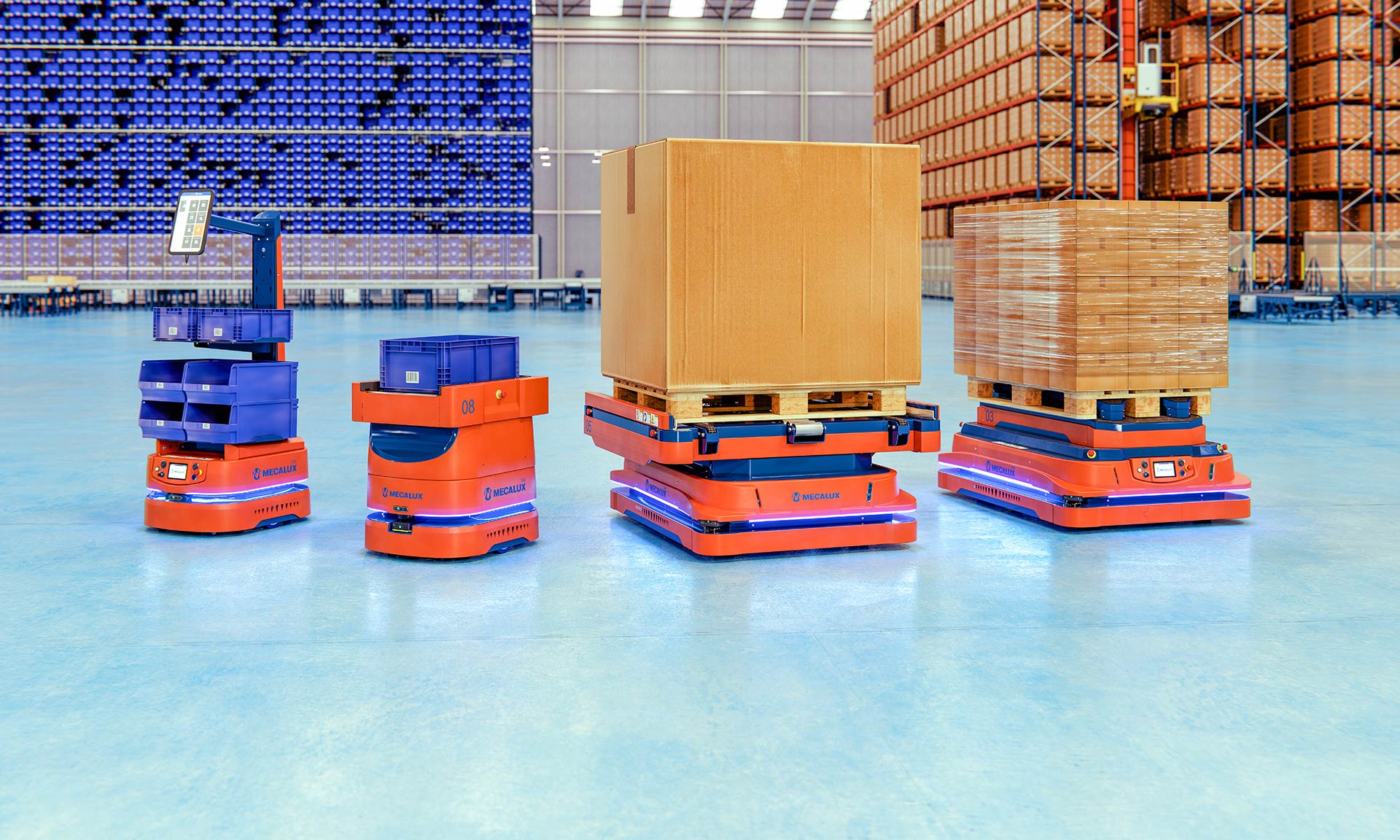
Autonomous Long-Load Handling & Mobile Cantilever
Eliminate wasted aisle space by up to 50% with motorized mobile bases and multidirectional automated vehicles.
MECALUX RACKING: The Structural Standard in Long-Load Storage
Standard pallet racks impose rigid front upright constraints that make storing steel pipes, lumber packs, extruded aluminium, and sheet metal hazardous and inefficient. Cantilever Racking eliminates front vertical columns, providing completely unobstructed horizontal storage bays. Backed by 60 years of structural design, 12 cutting-edge manufacturing facilities, and 7 R&D technology centres, MECALUX RACKING delivers cantilever engineering tailored precisely to your SKU deflection limits, seismic classifications, and throughput cycles.
Engineered Cantilever Racking Configurations for Heavy Industry
From light conduit bundles to multi-tonne hot-rolled structural steel coils, MECALUX RACKING designs and manufactures bespoke cantilever setups matching load profiles and material handling equipment.
Heavy-Duty Structural Cantilever
Designed for the heaviest industrial environments. Manufactured from European hot-rolled IPE steel profiles to store structural steel beams, thick tubing, heavy coils, and stone slabs.
- Arm capacities from 500 kg to over 3,000 kg per arm
- Single-sided or double-sided central column structures up to 12m high
- Articulated pin connections preventing catastrophic column twist upon impact
Light & Medium-Duty Cantilever
Ideal for manual picking and lighter forklift handling. Constructed with high-yield cold-rolled steel profiles for PVC piping, timber battens, moulding, and automotive components.
- Fast 50mm vertical arm height adjustments without special tooling
- Optional steel grating or mesh shelves for storing non-standard, fragmented goods
- End-stops, retainers, and divider pins to eliminate cylinder rolling hazard
Outdoor Cantilever Sheds & Canopies
Turn outdoor storage yards into self-supporting, sheltered facilities. The cantilever uprights act as the primary structural pillars supporting integrated roof trusses and water gutters.
- ISO 1461 hot-dip galvanizing for decades of zero-maintenance corrosion protection
- Calculated for local snow load, dead load, and high wind uplift forces
- Integrated side cladding, PVC rainwater drainage, and internal lighting conduits
Mobile & Automated Cantilever AS/RS
Double capacity within existing square metres. Cantilever racks mounted on motorized mobile bases slide along embedded rails, opening aisles on demand via remote or WMS software.
- Cuts floor space consumption by up to 50% compared to static cantilever lanes
- Integrated photoelectric safety barriers and emergency stop floor cables
- Available as automated AS/RS with stacker cranes for heavy 6m-12m bar bundles
The Engineering Physics Behind Cantilever Deflection & Load Safety
Procuring cantilever racking requires strict attention to mechanical deflection, cantilever arm connections, floor anchor shear, and dynamic vehicle impact. Here is how our engineers mitigate risk.
1. Calculating Point Loads vs Uniformly Distributed Loads (UDL)
In standard racking, beams are supported at both ends, experiencing simple bending moments. Cantilever racking, however, operates as an open-ended horizontal cantilever: the bending moment increases exponentially from the free arm tip to the upright junction, reaching peak stress at the root weld or pivot pin. If an irregular cargo concentrates weight toward the tip of the arm rather than being uniformly distributed, the resulting bending moment can double, risking elastic deformation or permanent structural yield.
At MECALUX RACKING, every installation undergoes proprietary Finite Element Analysis (FEA). We evaluate not only the gross package weight, but also longitudinal sag between column bays, centre-of-gravity displacement, and dynamic impact factors caused when heavy steel or lumber is lowered by side-loading forklifts.
Critical Deflection Standard: FEM 10.2.09 & ANSI MH16.2
Under maximum design load, cantilever arms are engineered with an upward factory camber (typically 1.5° to 2°). As the arm is loaded, it deflects to a horizontal plane. Under full operational capacity, total deflection must not exceed L/200 to L/150 of arm length L, preventing goods from sliding forward or compromising forklift clearance during high-reach retrieval.
2. Column Base Anchor Shear and Seismic Stability
Unlike selective pallet racking frames connected across aisles by top ties and cross-beams, single-sided cantilever columns must resist overturning overturning moment entirely through their bottom base plate and ground anchors. The anchor bolts embedded into the concrete slab endure intense tensile uplift forces. MECALUX RACKING structural engineers calculate slab thickness, concrete compressive strength (C20/25 or higher), and seismic ground acceleration zones before specifying chemical anchor depths and heavy base gusset reinforcements.
3. Articulated Pivots vs Rigidly Welded Cantilever Arms
Warehouse lift trucks operate in narrow aisles where accidental vertical impact is the primary cause of rack failure. Rigidly bolted arms transfer lifting force directly into the column flange, often tearing the steel face or destabilizing upper tiers. MECALUX RACKING incorporates articulated pivot pin joints: if an operator catches an arm from beneath while raising a load, the arm harmlessly rotates upward around its heavy-duty shear pin without transmitting destructive moments into the main upright column.
Upright Profile Selection
Our columns are forged from hot-rolled IPE steel profiles ranging from IPE 180 to IPE 500, offering structural rigidity against both horizontal wind loads and vertical deadweights. Cold-rolled profiles are selectively utilized in light-duty picking facilities to provide economical, high-tensile versatility.
Material Traceability & Standards
Every structural batch conforms to EN 10025 structural steel specifications. Full 3.1 mill test certification guarantees high yield strength (S275JR, S355JR), ensuring uncompromised mechanical reliability in high-cycle distribution environments.
Technical Engineering Specs
Download our complete Cantilever Racking specification tables, including moment load formulas, arm profile depths, spacing calculation matrices, and safety sign compliance documents.
Cantilever Racking Specification Comparison
Compare load tolerances, structural steel categories, arm deflection profiles, and handling vehicle options to shortlist the ideal cantilever system for your operation.
| Racking System | Steel Grade & Fabrication | Max Arm Capacity | Column Heights | Arm Connection | Handling Equipment | Primary Industry Uses |
|---|---|---|---|---|---|---|
| Heavy Structural Cantilever | Hot-rolled European IPE beams (S275JR / S355JR) | Up to 3,500 kg per arm | Up to 12.0 m | High-shear articulated pivot pin | 4-way sideloaders, heavy counterbalanced forklifts | Steel service centres, pipe mills, heavy structural timber |
| Medium-Duty Roll-Formed | Cold-rolled high tensile steel sections | Up to 850 kg per arm | Up to 6.5 m | Tapered bolted flange connector | Reach trucks, articulated trucks | PVC piping, plastic profiles, mouldings, furniture frames |
| Outdoor Cantilever Sheds | Hot-dip galvanized IPE structural steel (ISO 1461) | Up to 3,000 kg per arm | Up to 10.0 m + Roof truss | Galvanized articulated pin | Rough-terrain forklifts, sideloaders | Lumber yards, outdoor construction supplies, scrap handling |
| Mobile Cantilever Racks | Heavy IPE mounted on motorized bogies | Up to 2,500 kg per arm | Up to 9.0 m | Pivot pin or high-torque bolt | Multidirectional reach trucks, guided sideloaders | Cold storage, aluminium extrusion, high-value tooling dies |
| Automated Cantilever AS/RS | Precision-machined structural tolerances | Engineered to project spec | Up to 30.0 m clad-rack | Rigid bolted with laser-survey alignment | Automated stacker crane with telescopic forks | Automotive raw stock, automated aerospace component storage |
Note: Maximum load ratings are calculated per arm based on Uniformly Distributed Loads (UDL). Point loads, eccentric loading, or dynamic crane operations require specialized arm stiffeners and custom structural calculations by MECALUX RACKING engineers.
Future Procurement Trends & Technological Advancements in Cantilever Storage
How evolving safety regulations, automated guided vehicles, green steel initiatives, and smart IoT monitoring are reshaping long-load intralogistics for the next decade.
1. Shift toward Automated AS/RS for Long and Awkward Loads
Historically, long-load handling was confined to manual forklift operations, resulting in substantial product damage, frequent arm impacts, and slow retrieval rates. The latest intralogistics trend is the integration of cantilever racking with automated storage and retrieval systems (AS/RS). Stacker cranes equipped with multi-stage telescopic forks or specialized vacuum-gripper shuttles navigate narrow cantilever aisles, handling 6-to-12-metre steel bar cassettes up to 30 metres in height with sub-millimetre precision.
MECALUX RACKING has led this transformation by coupling heavy cantilever structures with our proprietary Easy WMS software suite, allowing automated inventory allocation, batch rotation, and synchronized dispatch without manual intervention.
2. Guided Narrow Aisle (VNA) & Multidirectional AMRs
Floor footprint optimization is accelerating the transition from standard counterbalance forklifts (requiring 5-to-7-metre wide aisles) toward wire-guided multidirectional sideloaders and Autonomous Mobile Robots (AMRs) designed for long loads. These specialized vehicles transport 6-metre bundles sideways, shrinking required aisle clearances down to 2.2 metres. As warehouse real estate costs continue to rise globally, high-density narrow-aisle cantilever configurations represent the fastest-growing procurement category.
3. Decarbonized Steel & Environmental Product Declarations (EPDs)
Global procurement directors in multinational manufacturing, aerospace, and energy sectors now mandate certified sustainability metrics. MECALUX RACKING is committed to reducing embodied carbon across all production lines. By utilizing electric arc furnace (EAF) steel with high recycled content, low-emission powder coatings, and localized European and American production plants, we minimize logistics transit carbon and provide transparent Environmental Product Declarations (EPDs) for LEED and BREEAM green building certifications.
Real-Time Strain & Deflection IoT Sensors
Emerging smart cantilever projects now feature embedded strain-gauge sensors on critical lower cantilever arms. These IoT devices monitor deflection and vibration continuously, transmitting overload warnings to facility managers via WMS software before structural yield occurs.
Stringent Seismic Design Protocols
With changing seismic building codes (Eurocode 8, ASCE 7-22), cantilever racking requires advanced dynamic modal analysis. MECALUX RACKING structural engineers incorporate high-ductility base plates and specialized anchoring arrays to absorb ground acceleration waves safely.
Technical Specifications & Project Design
Receive comprehensive structural drawings, load capacity tables, and footprint simulations tailored directly to your building layout and long-load profiles.
Structural Excellence Backed by Global Engineering Leadership
MECALUX RACKING designs and manufactures storage systems governed by the most stringent structural standards. From FEM 10.2.09 cantilever design principles to EN 15512 safety factors, our installations operate seamlessly in multinational industrial enterprises across more than 70 countries.
MECALUX RACKING: Scale, Precision & Authority
of engineering excellence
countries in our commercial network
direct production facilities worldwide
R&D engineering & test centres
Frequently Asked Questions on Cantilever Racking
Answers to technical and commercial questions global buyers frequently ask when specifying cantilever systems.
How is cantilever arm deflection calculated and what is the allowable tolerance?
What is the difference between hot-rolled IPE and cold roll-formed cantilever racks?
Why are articulated pivot arms safer than rigidly bolted arms?
When should outdoor cantilever installations use hot-dip galvanizing over powder coating?
Can cantilever racking store palletized or non-continuous short loads?
How do handling equipment and aisle width impact cantilever project design?

Request a Tailored Cantilever Racking Design Study
Submit your product dimensions, maximum bundle weights, building clear height, and forklift specifications. Our structural engineering department will prepare a comprehensive FEA load layout and cost breakdown with zero obligation.
Supply Load Data
Share item lengths, unit weights, packaging method, and warehouse floor drawings.
Structural Calculation
Our engineers perform FEA simulations matching deflection, wind, and seismic standards.
Proposal & Direct Supply
Comprehensive CAD layout, manufacturing timeline, installation, and inspection schedule.