Push-Back Pallet Racking: High-Density Accumulation Systems
Maximise floor utilization up to 90%, cut handling cycles in half, and eliminate forklift rack collisions with custom nested cart and roller push-back systems.
Up to 6 Deep Pallet Accumulation Without Entering Lanes
Engineered to store 2 to 6 pallets per channel with single-aisle access, high structural rigidity, and certified European steel profiles.
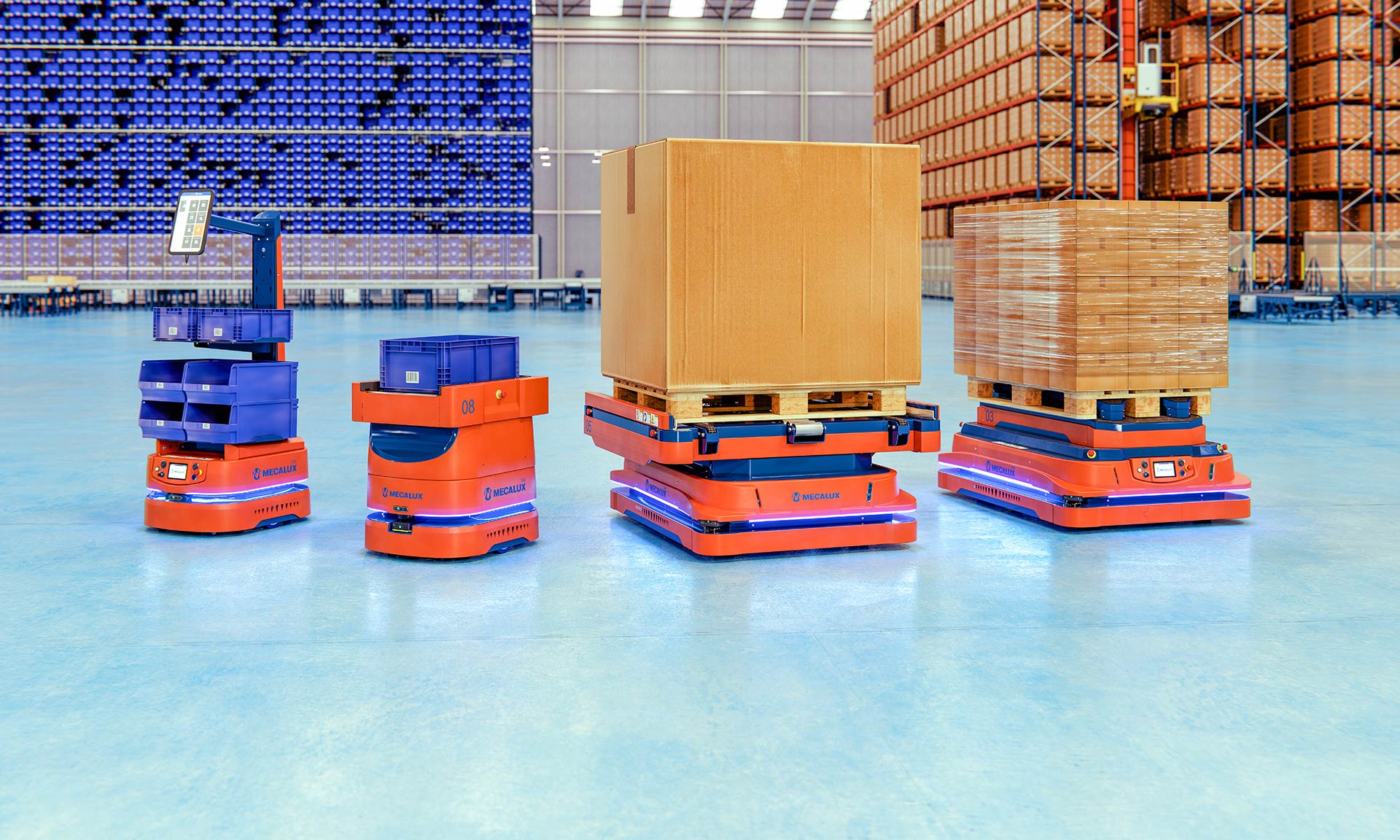
Built for Cold Stores & High-Throughput Hubs
Operating flawlessly down to -30°C with custom corrosion resistance and seamless integration into AMR and automated pallet shuttle interfaces.
Why Global Supply Chains Rely on MECALUX RACKING Push-Back Systems
Push-back pallet racking represents the optimum balance between high storage density and operational selectivity. Designed for medium-turnover inventory with multiple pallets per SKU, this accumulation storage system operates on a Last-In, First-Out (LIFO) loading dynamic. Unlike drive-in racks where forklifts enter deep channels, push-back racking allows operators to deposit and retrieve all unit loads directly from a single aisle using gravitational return. This design choice completely protects upright columns from structural forklift collisions, cuts unit handling time by up to 45%, and elevates warehouse safety standards across North America, Europe, Latin America, and Asia-Pacific facilities.
Product Recommendations: Push-Back Cart vs. Roller Configurations
Choosing between nested cart push-back and roller track systems depends on pallet quality, vertical clear ceiling height, seismic requirements, and lane depth goals. MECALUX RACKING provides custom tailored engineering for both structural variations.
Nested Cart Push-Back Racking (2 to 6 Deep)
Our nested cart configuration uses a series of precision steel carriages nesting inside one another along an inclined chassis rail. When loading, the forklift deposits the first pallet on the topmost cart. The operator then pushes this cart backward using the second pallet, placing it on the next cart below. This process repeats up to six pallets deep per channel.
- Tolerates poor, damaged, or variable wooden pallets with zero jamming risk
- Color-coded nested front carts allow operators to visually gauge lane capacity instantly
- Low maintenance precision flanged steel ball bearings rated for harsh temperature swings
Roller Bed Push-Back Racking (2 to 5 Deep)
Our roller track configuration utilises parallel beds of heavy-duty galvanized steel rollers mounted on a 3% to 4% slope gradient. Unit loads rest directly upon the rollers. The forklift pushes inbound pallets upward along the channel against gravity. Upon retrieval, internal centrifugal brake rollers govern downward rolling speeds safely to the front retrieval beam.
- Minimal profile height consumption, maximising pallet tiers beneath low roof trusses
- Integrated centrifugal speed governors prevent dynamic pallet runaway hazards
- Ideal for standard Euro pallets (800x1200mm) and GMA pallets (40x48 in) with bottom boards
Future Procurement Trends in Push-Back Pallet Racking
Supply chain procurement leaders are facing rising real estate costs, aggressive net-zero cold chain targets, and stringent workplace ergonomics. The following data highlights why international logistics buyers are shifting capital expenditure into high-density push-back racking systems.
| Evaluation Metric | Selective Pallet Racking | Drive-In Racking System | Push-Back Cart Racking (MECALUX) | Pallet Shuttle Automation |
|---|---|---|---|---|
| Floor Space Footprint Savings | Baseline (Low) | Up to 75% savings | Up to 90% floor density | Up to 95% floor density |
| SKU Selectivity & Access | 100% pallet access | 1 SKU per whole bay | 1 SKU per individual channel | 1 SKU per lane / channel |
| Forklift Collision Risk | Low | Severe (inside driving) | Zero inside rack collision | Zero inside rack collision |
| Handling Speed (Turnaround) | Standard (20-25 pal/hr) | Slow (12-16 pal/hr) | Rapid (35-42 pal/hr) | Automated (40-60 pal/hr) |
| CapEx Investment Level | Lowest initial cost | Moderate | Optimal Mid-Tier ROI | High automation CapEx |
| Cold Store Energy Savings | Poor (large air volume) | Good | Exceptional (compact cube) | Exceptional |
1. Cold Chain Space Monetisation
With refrigerated warehouse operating costs exceeding ambient facilities by up to 300%, procurement departments are using 4-to-6 deep push-back racking to compress conditioned air volume, yielding energy utility reductions of up to 32% year-on-year.
2. Decoupled Lift Fleet CapEx
Unlike complex automated systems requiring bespoke vehicles, push-back racking accommodates standard counterbalanced and reach lift trucks. Warehouses expand capacity without purchasing expensive dedicated turret or narrow-aisle trucks.
3. Rapid ROI Payback Durations
By removing internal channel driving, structural rack damage is virtually eliminated. Combined with reduced transit distances for operators, industrial operations frequently achieve a full capital return within 14 to 18 months of commissioning.
The Technological Evolution: From Pure Mechanical Carts to Connected Smart Racks
How Next-Generation Push-Back Systems Interface with AMRs, Smart Sensors, and WMS Software
Push-back pallet racking is no longer a static steel assembly. Modern intralogistics ecosystems demand interconnected physical infrastructure capable of communicating real-time volumetric capacity directly to Warehouse Management Systems.
MECALUX RACKING pioneers the integration of push-back accumulation storage with smart telemetry. Low-power IoT optical sensors mounted on channel stops monitor lane occupancy and nest cart positions in real time. When paired with our Gartner-recognized Easy WMS platform, the system predicts replenishment triggers automatically, eliminating lane starvation in high-velocity picking corridors.
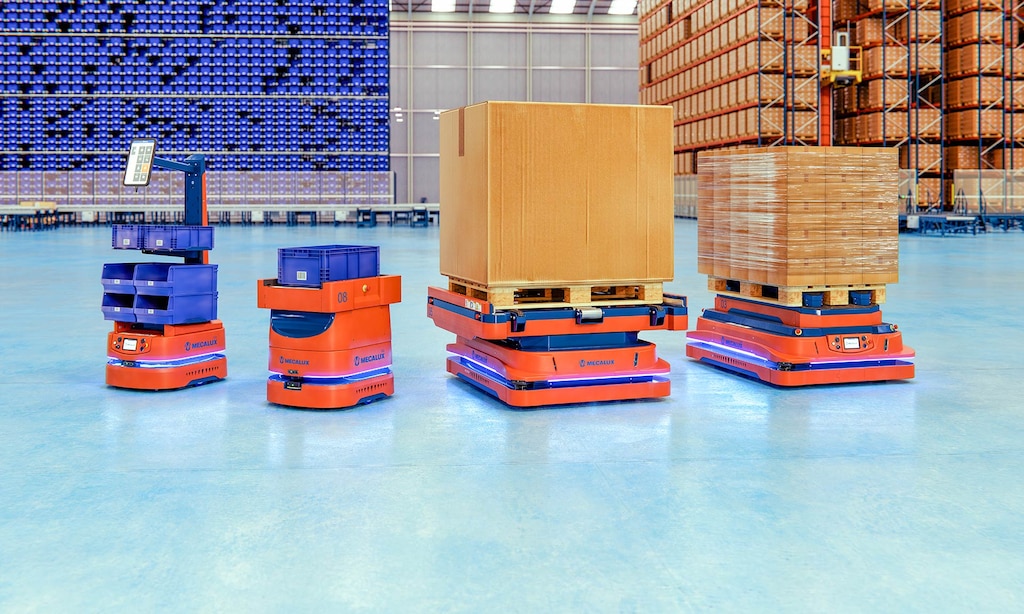
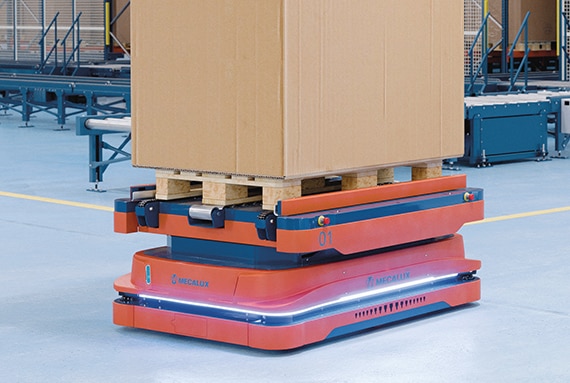
Furthermore, the physical loading interface is undergoing revolutionary transformation. Facilities are pairing push-back staging lanes directly with Autonomous Mobile Robots (AMRs) and Automated Guided Vehicles (AGVs). MECALUX RACKING precision-engineers nested cart entry bevels, dampening bumpers, and reinforced guide horns to match robotic mast positioning tolerances within ±2 millimetres.
Unrivalled Engineering Prowess & Manufacturing Mastery
At MECALUX RACKING, every push-back racking installation is custom-calculated by structural engineers to resist dead, live, seismic, and accidental impact loads in strict compliance with EN 15512, RMI, and FEM standards. Using high-yield certified steel fabricated in our 12 automated production centres, we deliver robust nested carts featuring precision flanged wheels, sealed bearings, and fail-safe mechanical stop catches designed for millions of operational cycles.
Push-Back Storage Deployments Worldwide
Discover how Fortune 500 manufacturers, third-party logistics providers, and food processors optimize distribution centers with MECALUX RACKING storage systems.
High-Density Dynamic Staging for Fast-Moving Beverage Pallets
PepsiCo deployed MECALUX RACKING high-density dynamic storage to support automated production lines. By storing multiple pallets deep per SKU with instant face retrieval, loading dock cycle times were reduced while maximizing pallet cube density within temperature-controlled staging zones.
Line-Side Parts Buffer & Raw Material Pallet Accumulation
Automotive manufacturer Renault utilizes engineered dynamic storage lanes to supply stamping and engine assembly lines in Seville. By buffering heavy engine component pallets in nested channels, factory floor space was conserved while securing uninterrupted parts feed.
Accumulation Storage Buffering Thousands of Hardware SKUs
Fastener distributor Würth installed custom accumulation pallet racking to bridge picking buffer areas with master bulk storage. The multi-deep channel structure allows rapid handling of heavy fastener containers while shielding structural frames from daily forklift damage.
Engineered Racking Backed by Global Scale
of racking & logistics engineering
countries in our commercial network
state-of-the-art production plants
dedicated R&D engineering hubs
World Brands Rely on MECALUX RACKING Infrastructure
Join over 10,000 successful enterprise warehousing installations installed across food processing, retail, chemical, pharmaceutical, automotive, and 3PL networks.


Frequently Asked Questions by Industrial Racking Buyers
Answers to key technical, logistical, and structural questions raised by warehouse managers, supply chain architects, and procurement officers.
What is the maximum depth and load weight capacity per push-back lane?
Cart-based push-back vs. roller track push-back: How do engineers evaluate the difference?
Can standard counterbalanced or reach forklifts operate with push-back racking?
Why is push-back racking safer and faster than drive-in racking?
How does MECALUX RACKING ensure reliability in cold storage (-30°C) environments?
What engineering parameters are needed for a push-back quotation and AutoCAD layout?

Accelerate Warehouse ROI with Push-Back Pallet Racking
Connect with our technical design team to receive a full structural proposal, 3D rack visualization, and clear cost comparison customized to your facility dimensions and pallet throughput requirements.
Submit Facility & Pallet Specifications
Provide your building dimensions, clear height, pallet dimensions, unit weight, and throughput targets.
Structural Calculation & Layout Simulation
MECALUX RACKING engineers evaluate nested cart vs. roller track options and calculate slab load distributions.
Direct Factory Supply & Global Commissioning
Manufactured in our 12 production hubs, shipped globally, and installed by certified intralogistics technicians.