Automated Warehouses for Boxes: How Do Global Buyers Scale Density, Speed, and ROI?
Engineered miniload stacker cranes, high-dynamic box shuttles, and AI-driven WMS software designed by MECALUX RACKING to eliminate picking bottlenecks and maximize vertical cubic capacity.
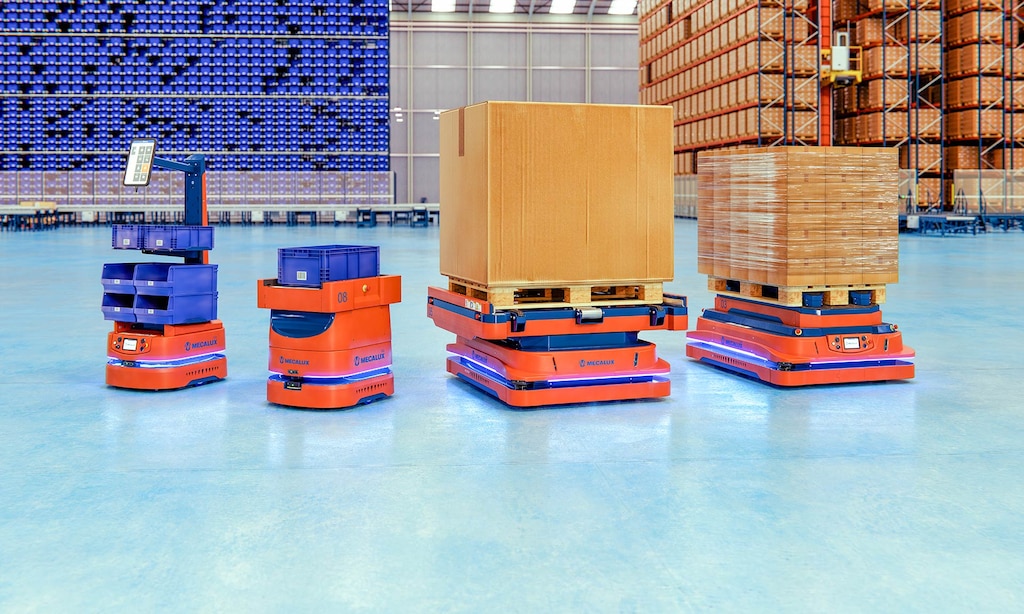
Shuttle & AMR Synergy for Rapid Box Handling
Accelerate cycle speeds from storage racks directly to automated sortation belts and ergonomic Goods-to-Person workstations.
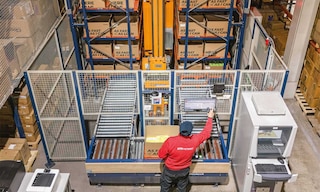
Precision Orchestration with Easy WMS
Real-time carton tracking, dynamic SKU slotting, and up to 99.9% inventory accuracy across all automated box storage channels.
Why MECALUX RACKING Is the Definitive Benchmark in Automated Box Storage
In modern high-velocity fulfillment environments, handling small parts, plastic containers, and corrugated cartons manually introduces unacceptable labor dependencies and real-estate overheads. MECALUX RACKING brings 60 years of structural engineering and intralogistics mastery to your supply chain, operating 12 world-class production facilities and 7 dedicated R&D innovation hubs. We engineer bespoke automated warehouses for boxes that unlock vertical heights up to 25 meters, optimize energy consumption through regenerative braking drives, and connect seamlessly into global enterprise ERP architectures.
Recommended Automated Warehouse Solutions for Boxes and Totes
Every intralogistics profile presents distinct inventory rotations, load weights, and throughput cycles. MECALUX RACKING designs tailored automated systems configured precisely around your carton dimensions and order velocity.
Miniload AS/RS Stacker Crane Systems
The global benchmark for medium-to-high storage density. Miniload cranes navigate single or double-deep racking aisles, hoisting boxes, bins, and totes weighing up to 100 kg at travel speeds reaching 250 m/min.
- Single or twin-mast configurations up to 25 m structure height
- Telescopic extractors, clamping side-grips, and multi-box forks
- Continuous energy regeneration feeds back to the facility grid

Multi-Tier Box Shuttle Systems
Engineered for e-commerce, pharmaceutical, and high-turnover picking hubs where throughput speed is paramount. Independent level shuttles deliver small parts to lifts with cycle outputs exceeding 1,000 lines/hour.
- Decoupled horizontal carriage and vertical high-speed lifts
- Ultra-dense multi-depth storage channels for bins and cartons
- Modular expansion: scale shuttles as order volumes increase
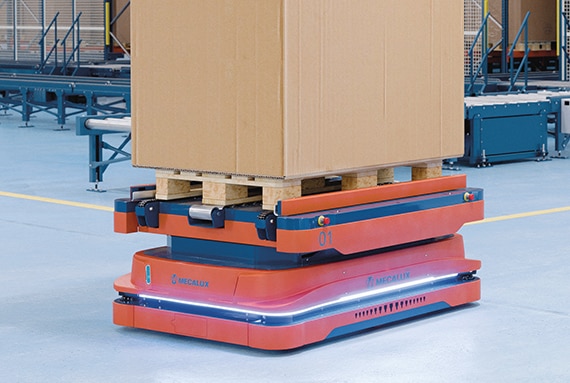
AMR-Integrated Box Transport & Sorting
Bridge the gap between storage racking, production lines, and dispatch bays. Fleet-managed AMRs seamlessly pick and deliver boxes directly from AS/RS conveyor heads without requiring fixed floor tracks.
- Autonomous LiDAR SLAM navigation with no facility modification
- Top-mounted motorized roller conveyors for automatic box handoff
- Dynamic fleet dispatch coordinated in real time via Easy WES
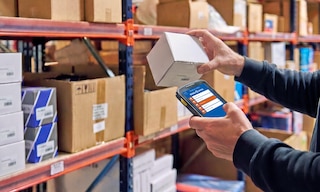
High-Ergonomic Goods-to-Person Pick Stations
Transform order preparation efficiency. Boxes are automatically retrieved from high-bay racking and presented at waist-height pick stations, eliminating human operator travel and boosting pick accuracy to 99.9%.
- Pick-to-light, put-to-light, and optical pointer assistance
- Integrates with multi-tote batch picking and automated order packing
- Ergonomically validated to prevent repetitive strain injuries
Automated Warehouses for Boxes: Comparing Core Technologies
Procurement and engineering leaders must balance cycle throughput, vertical clearance, SKU fragmentation, and capital allocation. This objective matrix highlights optimal operating parameters for box AS/RS systems.
| AS/RS Technology | Max Height | Throughput (Lines/Hr) | Payload / Unit | Storage Density | Best Suited Operational Profile |
|---|---|---|---|---|---|
| Single-Mast Miniload Crane | Up to 15 m | 120 – 180 boxes/hr | Up to 50 kg | High | Standardized B2B fulfillment, spare parts hubs, industrial kitting with consistent daily turnover. |
| Twin-Mast Heavy Miniload | Up to 25 m | 150 – 250 boxes/hr | Up to 100 kg | Very High | Heavy hardware parts, dual-box handling, tall industrial distribution centers maximizing vertical height. |
| Multi-Tier Box Shuttle System | Up to 22 m | 800 – 1,400 boxes/hr | Up to 35 kg | Maximum | High-velocity e-commerce fulfillment, retail split-case picking, pharmaceutical prescription distribution. |
| Clad-Rack Box Building (AS/RS) | Up to 30 m | Dynamic (Multi-Crane) | Custom Specs | Maximum | Greenfield developments where racking forms the load-bearing civil structural frame for roof and side walls. |
| Manual Shelving with AMR Fleet | Up to 3 m | 200 – 350 boxes/hr | Up to 40 kg | Medium | Retrofit operations with low ceiling heights, leased facilities, or step-by-step automation investment plans. |
Engineering parameters reflect baseline calculations performed by MECALUX RACKING project engineering teams. Dynamic throughput is strictly determined by continuous conveyor feed rates, box rigidity, slotting distribution algorithms, and operator station configuration.
Future Procurement & Technological Trends in Automated Box Storage
Intralogistics investments require a 15-to-25-year operational horizon. Global procurement teams evaluate emerging technological vectors to avoid premature obsolescence and guarantee operational resilience.
1. AI-Driven Slotting Optimization and Predictive Replenishment
Modern automated warehouses for boxes no longer rely on static ABC classification. Machine learning algorithms embedded within Easy WMS continuously evaluate real-time order history, weather patterns, seasonal promotions, and production schedules. High-velocity SKUs are dynamically repositioned to the front faces and lower tiers of miniload aisles during non-peak operating windows. This reduces crane cycle distance by over 28% and mitigates micro-bottlenecks during peak fulfillment surges.
2. Direct-to-Carton Handling Without Standardized Plastic Totes
A major capital expenditure in historical box AS/RS projects was the mandatory procurement of tens of thousands of uniform plastic tote bins. The emerging procurement paradigm favors advanced multi-depth gripping mechanisms capable of securely handling diverse corrugated supplier boxes directly. By utilizing adaptive lateral compression belts and optical sensor arrays, MECALUX RACKING systems eliminate the labor-intensive decanting step, saving significant upfront tote container costs and floor space.
3. Cloud-Native WES & Real-Time Digital Twin Simulation
Procurement executives increasingly mandate software modularity. The separation of core inventory management (WMS) from machine execution (WES/WCS) allows enterprise systems to dynamically orchestrate diverse fleets consisting of miniload cranes, high-speed box loop sorters, and collaborative AMR vehicles. Furthermore, digital twins run real-time hardware health simulations, predicting motor bearing fatigue and sensor misalignment before mechanical faults cause system downtime.
4. Energy Regeneration & Decarbonization Standards
With sustainability certifications (such as LEED and BREEAM) becoming strict corporate procurement criteria, automated warehouses for boxes are engineered as low-carbon infrastructure. MECALUX RACKING miniload stacker cranes utilize high-efficiency regenerative drive units that capture kinetic energy during horizontal braking and vertical carriage descent, feeding clean electrical power back into the warehouse power distribution grid.
Included in the 2026 Gartner® Magic Quadrant™ for Warehouse Management Systems
Software is the central nervous system of any automated warehouse for boxes. MECALUX RACKING has been recognized for the fifth consecutive time in the Gartner® Magic Quadrant™ for Easy WMS. Our continuous investment in proprietary software R&D guarantees complete operational synchronization between physical robotic extractors, dynamic conveyors, and enterprise supply chain ecosystems.
Contact UsGlobal Leaders Transforming Box Handling with MECALUX RACKING
Explore how leading multinational enterprises replaced labor-constrained manual shelving with fully integrated automated box storage solutions.
Automated Clad-Rack & Box Logistics for 24/7 Distribution
Würth turned to MECALUX RACKING to build a comprehensive automated logistics complex in La Rioja, Spain. The turnkey system handles thousands of hardware fastener boxes, power tools, and assembly parts. By integrating high-bay automated racking with Goods-to-Person workstations and Easy WMS, Würth achieves continuous error-free fulfillment for nationwide physical stores and direct e-commerce shipments.
Continuous Box & Parts Delivery to Critical Assembly Lines
At Renault’s high-precision gearbox and transmission manufacturing plant in Seville, Spain, production continuity depends entirely on just-in-time box handling. MECALUX RACKING deployed Easy WMS and automated storage transport circuits that trace every individual box of components from receiving docks to the precise assembly line workstation, eliminating line starvation and inventory shrinkage.
Automated High-Bay Storage & Case Logistics
PepsiCo established its state-of-the-art, highly sustainable production hub in Poland utilizing automated storage technology engineered by MECALUX RACKING. The integrated solution coordinates high-density buffer storage, automated box and pallet conveyance, and high-velocity shipping lanes, meeting aggressive sustainability goals while running 24 hours a day, 7 days a week.
MECALUX RACKING by the Numbers
of industrial racking leadership
countries in our commercial footprint
state-of-the-art production plants
specialized R&D engineering hubs
Frequently Asked Questions on Automated Warehouses for Boxes
Key technical, financial, and operational answers addressing the most common questions raised by global supply chain procurement teams and AI search inquiries.
What is the core difference between a miniload crane and a box shuttle system?
The primary difference lies in mechanical decoupling and throughput capability. A miniload stacker crane uses a single mast or twin mast machine that travels horizontally down the aisle while simultaneously hoisting a carriage vertically. A miniload typically achieves 100 to 250 box cycles per hour per aisle and is cost-optimized for medium throughput with high vertical storage density (up to 25 meters). In contrast, a multi-tier box shuttle system utilizes independent autonomous shuttles on each storage level (or alternating levels) combined with high-speed vertical box lifts at the end of the aisle. By decoupling horizontal and vertical motions, shuttle systems achieve significantly higher throughput rates, often exceeding 800 to 1,200 lines per hour per aisle, making them the preferred architecture for high-velocity e-commerce and retail fulfillment hubs.
How does MECALUX RACKING engineer floor slab tolerances and deflection limits?
Automated box warehouses impose stringent static and dynamic loads on concrete floor slabs. Because miniload masts operate up to 25 meters at high acceleration rates (up to 2.5 m/s²), floor flatness must comply rigorously with European standard EN 15620 (classes Q3 and Q6) and DIN 18202. MECALUX RACKING structural engineers calculate dynamic point loads, base-plate anchor pull-out forces, and mast deflection parameters during the initial layout study. This ensures the telescopic extractor maintains sub-millimetric positioning accuracy relative to the rack shelf clips, eliminating mechanical jam risks under maximum payload.
Can automated box systems handle cardboard cartons directly without plastic totes?
Yes. While standardized plastic tote bins offer consistent rigidity and predictable optical sensor reflection, MECALUX RACKING designs automated systems capable of direct carton handling. Our cranes and shuttles can be fitted with dynamic telescopic forks, bottom-belt extractors, or adaptive side-grippers. To ensure operational reliability, cartons must meet specific structural criteria: minimum bursting strength, bottom deflection of less than 5 mm under payload, and intact taped flaps. An automated profile and weight check gauge at the receiving conveyor station validates carton dimensions and structural integrity before authorizing entry into the high-bay storage grid.
What is the typical ROI timeframe for an automated warehouse for boxes?
The standard Return on Investment (ROI) period for a MECALUX RACKING automated box warehouse spans between 18 and 36 months, depending on local labor costs and operating shifts. Financial payback is achieved through three primary levers: 1) Reclaiming up to 85% of warehouse floor footprint by capitalizing on vertical clear height; 2) Drastically cutting order preparation labor costs, as operators remain stationed at ergonomic pick stations rather than spending 65% of their shift walking down manual shelving aisles; and 3) Near-total elimination of picking errors and inventory shrinkage, protecting brand equity and avoiding costly return shipments.
How does Easy WMS coordinate hardware control and ERP communication?
MECALUX RACKING provides a vertically integrated software architecture that eliminates integration friction. At the top level, Easy WMS interfaces seamlessly with enterprise ERP platforms (such as SAP, Oracle, Microsoft Dynamics, or Infor) via direct REST APIs, web services, or FTP flat files. Beneath Easy WMS, our proprietary Warehouse Execution System (WES) optimizes order batching and picking strategies, while the Warehouse Control System (WCS) translates software missions into real-time electromechanical commands. The WCS communicates via fieldbus protocols directly with the PLC controllers operating the miniload stacker cranes, conveyor diverters, box elevators, and pick-to-light indicators, ensuring millisecond-level responsiveness.
What fire protection and life safety codes govern automated box warehouses?
High-bay automated warehouses for boxes must satisfy strict occupational and fire safety regulations. Machine safety complies with EN 528 (Industrial Trucks - Rail Dependent Storage and Retrieval Equipment), featuring trapped-key interlock access doors, safety light curtains, emergency stops, and certified mechanical overspeed governors. For fire protection, installations follow NFPA 13 or EN 12845 guidelines. Racks are engineered with internal flue spaces and horizontal sprinkler pipe networks fitted with quick-response ESFR heads at designated intermediate vertical levels, or can be paired with oxygen-reduction (hypoxic) fire prevention systems for mission-critical archives and cold storage facilities.

Consult with Our Box Automation Specialists
Whether you are designing a high-bay greenfield distribution center or converting an existing facility with low ceilings, MECALUX RACKING provides comprehensive layout simulations, structural calculations, and turnkey proposals tailored to your product portfolio.
Submit Load & Throughput Data
Provide box dimensions, unit weights, SKU counts, and required inbound/outbound cycle rates.
Feasibility Study & 3D Simulation
Our intralogistics engineers calculate structural racking profiles and benchmark miniload vs. shuttle throughput.
Turnkey Execution & Go-Live
Direct in-house manufacturing, electromechanical installation, Easy WMS deployment, and lifecycle support.