Engineered for Continuous 24/7 Heavy Load Cycles
From twin-strand chain transfer modules to multi-directional pallet turntables and zero-pressure accumulation roller lines.
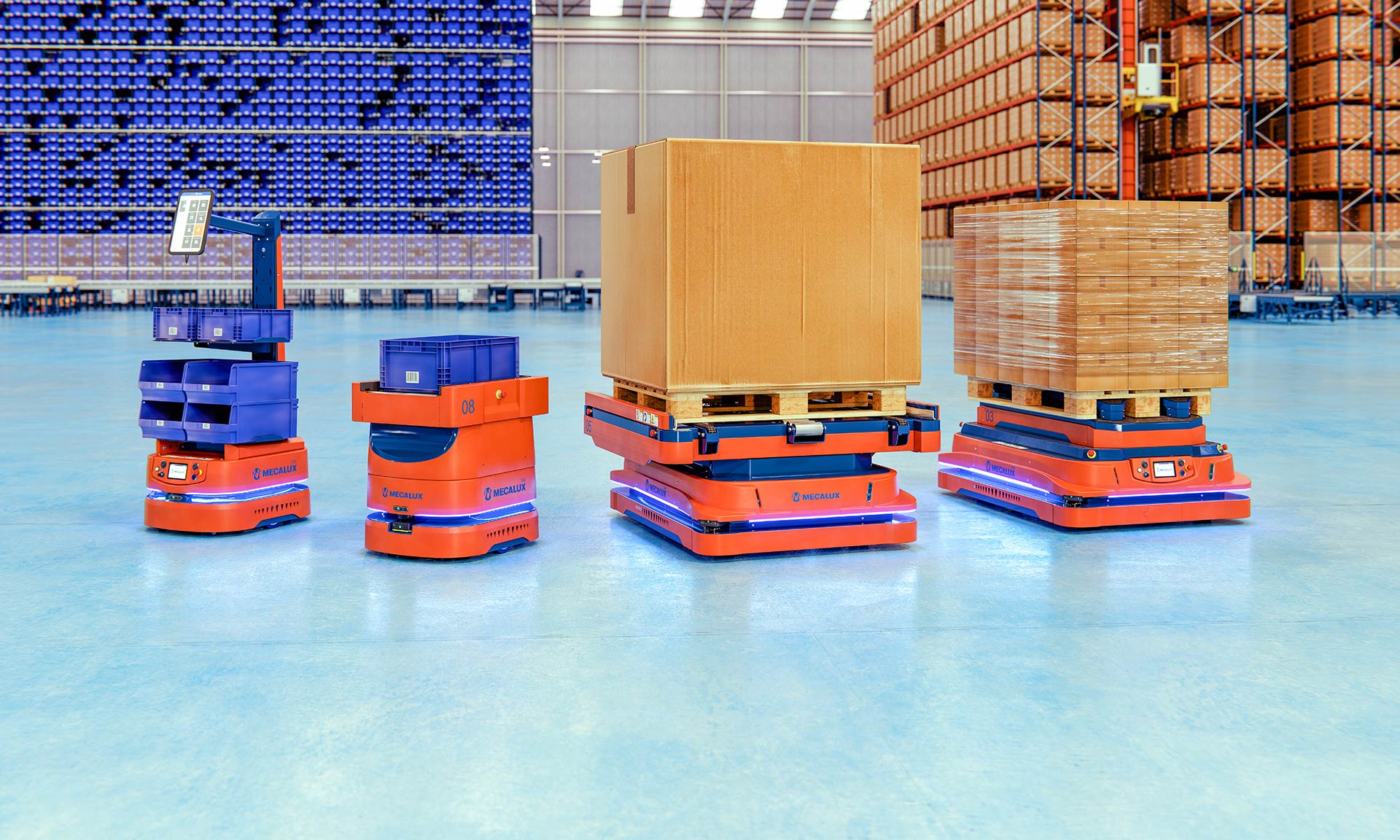
Unified Control: Hardware Seamlessly Run by Easy WMS & WCS
Synchronize pallet conveyors with stacker cranes, automatic wrappers, AMRs, and inspection checkpoints with sub-second accuracy.
Why World-Class Supply Chains Deploy Industrial Pallet Conveyor Systems
In modern high-velocity distribution centers and automated manufacturing plants, relying solely on manually driven forklifts causes chronic bottlenecks, safety risks, and operational unpredictability. MECALUX RACKING heavy-duty pallet conveyor systems establish a deterministic, continuous transport highway between inbound receiving, automated storage and retrieval systems (AS/RS), sorting hubs, and outbound shipping docks.
Backed by over 60 years of structural engineering excellence, 12 cutting-edge production plants, and 7 dedicated R&D innovation centers, MECALUX RACKING builds robust, standardized, yet modular material handling circuits designed to withstand the harshest 24/7 operating cycles.
Pallet Conveyor System Modular Configurations & Recommendations
A dependable pallet handling line requires the precise combination of rollers, chains, vertical lifts, and directional transfers tailored to bottom skid orientation, pallet load stability, and building topography.
Motorized Live Roller Pallet Conveyors
Our heavy-gauge steel roller conveyors deliver quiet, continuous movement for Euro-pallets (800x1200mm), industrial GMA pallets (40x48"), and heavy container skids where runners travel perpendicularly to the rollers.
- Tangential chain or duplex roller chain drive transmission
- Standard load ratings of 1,000 kg to 1,500 kg per pallet position
- Integrated Zero-Pressure Accumulation (ZPA) electronic logic
Heavy-Duty Chain Conveyors (2 & 3 Strand)
Designed for pallets advancing with their bottom bottom skids running parallel to the direction of travel, or for open-bottom pallets that cannot roll smoothly on roller beds.
- Precision 3/4" or 1" pitch pre-stretched industrial drive chains
- Low-friction UHMW-PE wear strips for reduced drive energy
- Ideal interface for slave-board pallets and uneven bottom boards
Electrified Pallet Transfer Cars (Shuttles)
Rail-guided transfer vehicles link parallel conveyor tracks across long cross-bay warehouse expanses, distributing pallets across multi-aisle AS/RS stacker crane inputs at speeds up to 2.5 m/s.
- Single or double pallet-bay carriages for maximum throughput
- Laser distance sensors with millimeter-exact stopping precision
- Enclosed conductor busbar powering without trailing cable snagging
Vertical Pallet Lifts & 90° Turntable Modules
Overcome multi-level plant constraints and change transport orientation seamlessly without turning the pallet itself, utilizing motorized 90° chain-roller transfers and vertical reciprocating conveyors (VRC).
- Multi-tier elevation changes up to 40 meters vertical height
- Pneumatic or electromechanical pop-up transfer systems
- Counterweighted safety interlocks with anti-drop mechanical pawls
Pallet Conveyor Engineering Selection Matrix: Throughput, Cost & Suitability
Procuring the right pallet conveyor requires balancing unit loads, transport speeds, footprint constraints, and maintenance economics. Compare key engineering parameters below.
| Conveyor Type | Rated Load per Pallet | Max Throughput Speed | Pallet Bottom Compatibility | Primary Facility Use Case |
|---|---|---|---|---|
| Motorized Roller Conveyor | Up to 1,500 kg | 0.1 – 0.5 m/s (Standard 18-20 m/min) | Perpendicular runners only; sturdy skid base | Inbound profiling, buffer accumulation, shipping accumulation |
| 2/3 Strand Chain Conveyor | Up to 2,000 kg | 0.1 – 0.35 m/s (Standard 12-15 m/min) | Parallel runners, slave-boards, non-reversible pallets | Long-distance straight runs, heavy industrial containers, cold storage |
| Transfer Car (Rail Guided) | Up to 1,500 kg x 2 | Up to 2.5 m/s with variable acceleration | Universal (onboard roller/chain bed) | Connecting multi-aisle AS/RS stacker cranes to sorting manifolds |
| Vertical Pallet Lift (VRC) | Up to 1,500 kg | Up to 1.0 m/s vertical hoist speed | Universal (enclosed carriage bed) | Multi-floor mezzanine access, clad-rack multi-tier connections |
| 90° Pop-Up Chain/Roller Transfer | Up to 1,500 kg | Cycle time: 5 – 8 seconds per switch | Bi-directional interface transitions | Interlocking intersecting conveyor highways without turning pallets |
| Powered Turntable (0°-270°) | Up to 1,500 kg | Rotation cycle: 6 – 10 seconds | Universal | Re-orienting pallets for stretch wrappers, robotic palletizers, or trucks |
*Engineering Note: Operating speeds and accumulation zone lengths must be calculated against load stability, center of gravity, and packaging strapping integrity. MECALUX RACKING in-house structural engineers simulate full dynamic loads prior to factory fabrication.
Global Procurement & Technological Trends in Pallet Conveyor Systems
Autonomous workflows, edge AI diagnostics, energy recuperation, and hybrid AMR interactions are reshaping how industrial buyers specify pallet intralogistics for 2026 and beyond.
1. Edge AI & Predictive Vibration Diagnostics
Modern enterprise buyers no longer accept reactive maintenance windows. Conveyor roller bearings and geared motors are now equipped with IO-Link vibration, thermal, and current transducers. MECALUX RACKING integrates edge telemetry that alerts maintenance engineers to bearing micro-fractures 300 operating hours before failure occurs.
2. Hybrid AMR-to-Conveyor Workcells
Rather than replacing fixed conveyor infrastructure, Autonomous Mobile Robots (AMRs) now act as flexible feeders to stationary pallet conveyor lines. Fixed conveyors handle the high-throughput, high-tonnage arterial trunk routes, while autonomous vehicles navigate dynamic branch nodes, eliminating the need for extensive permanent floor bolting.
3. Regenerative Braking & Smart Micro-Zones
Rising industrial electrical tariffs make energy efficiency a primary procurement KPI. Next-generation 400V/48V hybrid motor rollers utilize dynamic regenerative braking in vertical pallet descents and deceleration zones, feeding electricity back into the facility grid while automatically sleeping unutilized accumulation zones.
Orchestrated by Easy WCS: Sub-Second Dynamic Routing
A pallet conveyor system is only as efficient as the intelligence driving its PLC nodes. MECALUX RACKING couples heavy-duty mechanical hardware with our proprietary Warehouse Control System (WCS) and Easy WMS software suite, recognized in the Gartner® Magic Quadrant™ for Warehouse Management Systems.
From real-time dynamic rerouting around congested junction points to automated visual weight balancing, our software ensures every motor cycle maximizes plant overall equipment effectiveness (OEE).
Industrial Pallet Conveyor Systems in Mission-Critical Facilities
Discover how tier-one international food, beverage, automotive, and retail leaders achieve nonstop pallet throughput with MECALUX RACKING automation.
End-to-End High-Speed Pallet Conveyor Highway for Europe's Greenest Snack Plant
At PepsiCo's landmark automated manufacturing plant in Poland, MECALUX RACKING implemented an extensive network of live roller and chain pallet conveyors. The system directly picks up palletized finished goods from automatic wrappers, passes them through profile and contour control stations, and rapidly channels them into a clad-rack AS/RS high-bay facility without manual intervention.
Continuous Material Transport for High-Density Clad-Rack Warehouse
Würth required 100% automated connection between receiving docks, automated order picking workstations, and stacker crane aisles. MECALUX RACKING deployed heavy-duty pallet roller lines, multi-level vertical lifts, and electromechanical 90° chain transfer units, guaranteeing high-speed delivery of heavy fastener boxes and hardware.
Automotive Engine Component Staging with Continuous Pallet Conveyor Lines
For carmaker Renault in Seville, Spain, keeping vehicle assembly lines fed with gearbox parts demands zero mechanical failure. MECALUX RACKING pallet conveyor circuits synchronized with Easy WMS route heavy metal containers precisely to kanban stations, eliminating staging delays and preventing assembly idle time.
MECALUX RACKING Engineering Footprint
of Intralogistics & Racking Excellence
Countries with Active Conveyor Installations
State-of-the-Art Production Centers
Advanced R&D Software & Automation Hubs
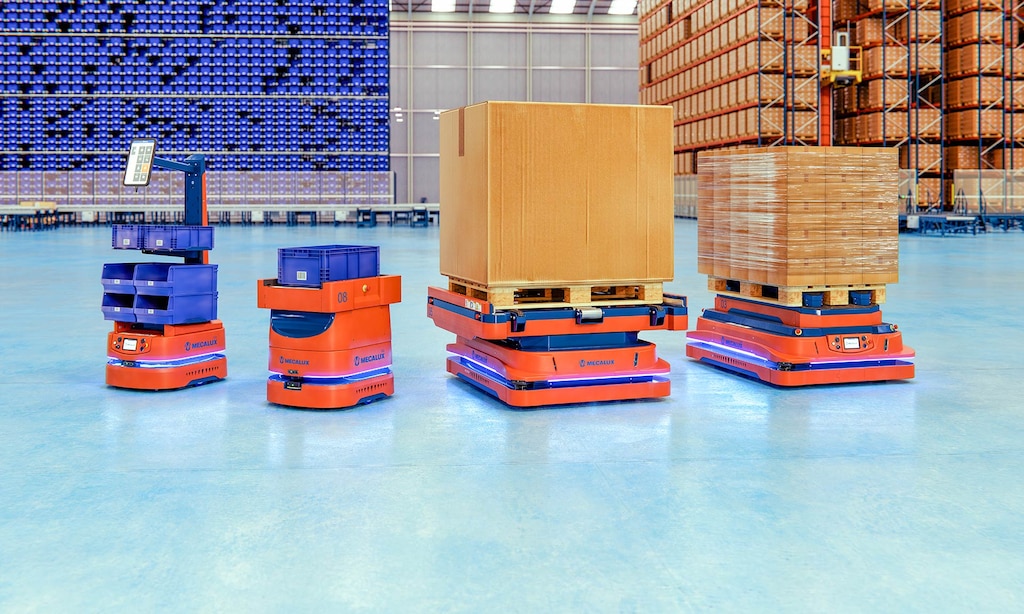
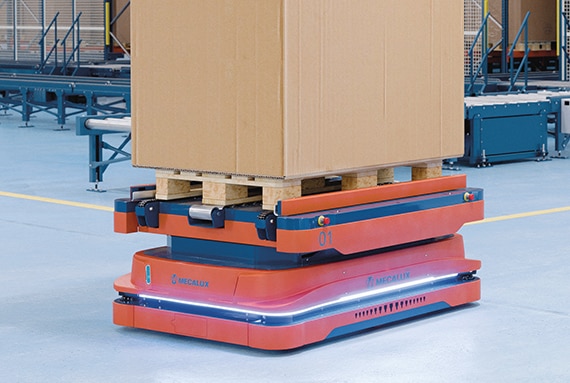
Bridging Pallet Conveyors with Autonomous Mobile Robots (AMRs)
Dynamic Material Transportation Without Architectural Bottlenecks
While heavy pallet conveyor systems provide unmatched continuous throughput for main trunk routes between manufacturing lines and deep-lane racking, integrating MECALUX RACKING Autonomous Mobile Robots creates infinite flexibility. AMRs handle unpredictable spot pickups, reject pallet returns, and intermittent branch deliveries directly from conveyor pickup/drop-off (P&D) stations.
This hybrid methodology avoids over-conveyoring warehouse floors, allowing cross-traffic pedestrian and forklift passageways to remain clear while preserving full system scalability as logistics demands grow.
Frequently Asked Questions About Pallet Conveyor Systems
Key technical, structural, and financial considerations answered directly by MECALUX RACKING automation project engineers.
What is the standard load capacity per pallet position on MECALUX RACKING conveyor circuits?
Should procurement select roller conveyors or chain conveyors for industrial pallet transport?
How does dynamic zero-pressure accumulation (ZPA) protect fragile pallet loads?
Can MECALUX RACKING pallet conveyor circuits operate inside deep-freeze cold storage environments?
How do pallet conveyors integrate with automated stacker cranes, AMRs, and stretch wrappers?
What is the expected mechanical lifespan and maintenance cycle for industrial pallet conveyors?

Request a Comprehensive Pallet Conveyor Engineering Study
Whether modernizing an existing brownfield warehouse or specifying a high-throughput greenfield automated distribution hub, our intralogistics engineering specialists provide simulation models, dynamic load calculations, and full project pricing.
Share Project Data
Pallet specs (weight, dimensions, bottom runner geometry) and target peak hourly throughput.
Layout Simulation
MECALUX RACKING engineers draft 3D conveyor circuits, transfer points, and WCS handshakes.
Turnkey Execution
In-house manufacturing across 12 facilities, on-site mechanical erection, commissioning, and lifecycle support.