0%

Choosing Heavy Duty Drive In Racking is not simply a matter of selecting the tallest frame or the lowest price. The right system depends on pallet dimensions, load weights, forklift access, available floor space, and how often stock moves. Drive-in layouts can increase storage density by allowing forklifts to enter dedicated lanes. That density comes with trade-offs. Forklift clearance, pallet consistency, and loading practices all affect how reliably the system works.

Start with real operating details. Measure the building’s clear height, aisle widths, column positions, and floor condition. Record the heaviest pallet load, including its contents, and check whether pallet sizes vary between suppliers. These details help determine lane depth, entry clearances, and the required rack capacity. They also reveal whether a drive-in arrangement suits the inventory’s rotation pattern. Slow-moving, similar products often fit the system better than mixed goods that need frequent individual access.

Safety matters every day. Inspectors and qualified rack professionals should review the proposed design, installation, floor capacity, and protection for vulnerable uprights. Ask suppliers for load information and clear documentation, rather than relying on a catalogue image. Small details matter. A slightly uneven floor or a poorly aligned pallet can create problems inside a deep lane. The best choice is not always the densest one. Compare storage gains with access time, stock rotation, and forklift movement, then confirm the design against your actual site conditions. Some assumptions may change after a site survey, and that is worth acknowledging before purchase.
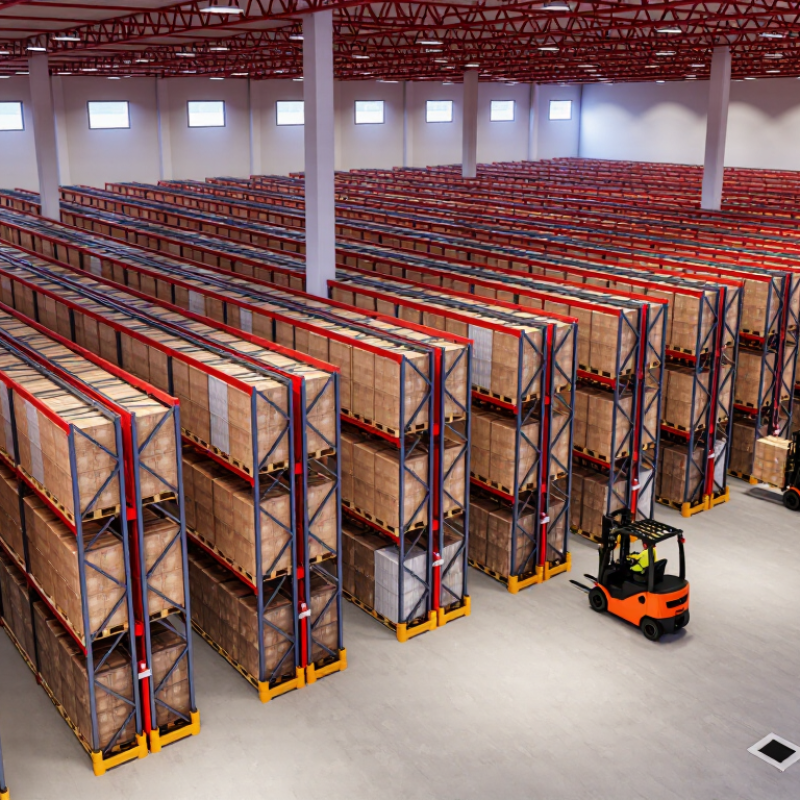
How to Choose Heavy Duty Drive In Racking?

Define Drive-In vs. Drive-Through Racking and Their LIFO/FIFO Flow

Drive-in and drive-through racks both let forklifts enter storage lanes, reducing the number of access aisles.

In drive-in layouts, one end of each lane is closed.

A forklift loads and retrieves pallets from the same side, so the last pallet placed is usually the first removed: last-in, first-out (LIFO).

This suits products stored in batches, such as seasonal goods, when older stock does not need to ship first. Deep lanes save aisle space. But a blocked pallet may sit longer than planned.

Drive-through racks remain open at both ends.

Pallets enter from one side and leave from the other, supporting first-in, first-out (FIFO) flow. That can help when stock rotation matters, including dated goods.

It also requires clear traffic separation and disciplined replenishment.

MHI’s 2024 Annual Industry Report found that 55% of respondents planned to increase supply-chain technology investment over the next two years. That figure is not a racking performance guarantee; it points to the value of matching storage design with inventory data.

Before choosing, check pallet dimensions, forklift turning clearance, lane depth, and daily pick patterns. A layout can look efficient on paper. Real operations may disagree.

Use the 48 × 40 in GMA Pallet as a Common Load-Planning Baseline

Choosing heavy duty drive-in racking starts with a realistic pallet baseline. The 48 × 40 inch GMA pallet remains a practical planning reference across many North American warehouses. MHI’s 2024 Annual Industry Report found that 55% of supply chain professionals planned to increase technology investment, reflecting continued pressure to improve storage density and control labor costs. Drive-in systems address density, but they demand accurate load data.

Treat each GMA pallet as 48 inches deep and 40 inches wide before adding rack clearances. A 10-pallet lane, for example, requires more than 400 inches of usable depth. Allow extra space for pallet deformation, forklift movement, load overhang, and beam or rail tolerances. Do not design from the nominal size alone. The RMI Specification for the Design, Testing and Utilization of Industrial Steel Storage Racks emphasizes verified capacities, proper installation, and visible rack identification. Every level should match the pallet weight, not merely its footprint.

Check the actual pallet samples. They may vary.

A 2,000-pound load needs different structural assumptions from a 1,200-pound load. Confirm the heaviest unit, load height, pallet condition, and entry direction. OSHA 29 CFR 1910.176(b) requires stored materials to remain secure against sliding or collapse. In practice, I would measure loaded pallets during receiving, because packaging can extend beyond the 48 × 40 inch base. My earlier designs sometimes allowed too little side clearance. That mistake looked harmless on paper. It was not.

Planning baseline: A common GMA pallet measures 48 × 40 inches, giving a nominal footprint of 1,920 square inches (13.33 square feet). Use these dimensions as a starting point when evaluating drive-in racking; confirm actual load dimensions, overhang, required clearances, and rack specifications before finalizing a layout.

Calculate Lane Depth, Forklift Clearances, and Aisle Requirements

Choosing heavy-duty drive-in racking starts with the pallet, not the frame. Measure the actual load depth, including overhang, wrap, and damaged corners. A lane for four pallets needs four load depths, plus handling clearance and a backstop allowance. Do not treat the nominal pallet size as exact. It rarely is. For example, four 1,200-millimeter loads may require more than 4,800 millimeters of usable lane depth. Add space for load variation, insertion, and rear protection. Confirm the final dimension with a qualified rack engineer and site survey.

Forklift clearances must match the truck used every day. Check overall width, mast height, fork length, turning behavior, and operator sightlines. Keep enough side clearance for pallet placement without scraping uprights. Vertical clearance should include load height, pallet deflection, beam tolerance, and safe movement under the top rail. A few extra millimeters can prevent repeated impacts. Too much clearance wastes cubic capacity and may reduce stability if loads shift.

Aisle requirements depend on the forklift’s working aisle, load length, and approach angle. Mark the aisle on the floor and test a fully loaded truck, not an empty one. Observe entry, deep storage, and the exit turn. This practical check often exposes interference that drawings miss. I have seen clean layouts fail because a door column narrowed one approach. Recheck floor capacity, lighting, rack protection, and emergency routes before installation. Record the tightest maneuver and revise the layout before drilling anchors.

Verify Rack Loads and Design to ANSI MH16.1

How to Choose Heavy Duty Drive-In Racking?

Verify rack loads and design against ANSI MH16.1 before comparing prices or storage density. Drive-in systems carry pallets on rails, so load paths differ from selective racks. Confirm the pallet weight, dimensions, entry direction, and number of pallets stored in each lane. Do not rely on a general capacity label. Ask for a stamped design or engineering documentation that identifies upright frames, rails, bracing, connections, and allowable loads.

The current ANSI MH16.1 requirements should guide the structural review, while local building and seismic rules may add further demands. Check the floor capacity and anchor details carefully. Uneven concrete can affect frame alignment and rail performance. Forklift impact protection also matters, especially near tunnel entrances. A small collision can distort a column before anyone notices it.

Review the design with a qualified rack engineer or competent storage specialist. Inspect the actual pallets, not only the drawings. Their bottom boards may sag, or their dimensions may vary between suppliers. That detail can change clearances and loading behavior. I would also request a visible load plaque for every rack configuration. It is easy to overlook this step. A design may appear strong, yet the wrong pallet, spacing, or installation detail can reduce its safe working capacity. Record inspections and correct damaged members promptly, even when the rack still looks usable.

Compare Storage Density, SKU Count, and Selectivity Before Choosing a Layout

How to Choose Heavy Duty Drive In Racking?

Drive-in racking suits warehouses holding many pallets of the same SKU. It can reduce aisles and increase storage density, but access becomes limited. A practical layout review should record SKU count, pallets per SKU, turnover rate, pallet dimensions, and required loading sequence. If one SKU fills six lanes, deep storage may work well. If ten SKUs share twelve pallets, it may create blocked inventory and extra handling.

Storage density is not free capacity. A drive-in system commonly supports deep pallet storage, yet the usable result depends on forklift clearance, rack depth, fire protection, and pallet condition. The 2024 MHI Annual Industry Report found that 55% of respondents planned to increase supply chain technology investment. This supports using inventory data before buying equipment, rather than trusting a simple capacity estimate. Keep it measurable.

Selectivity often deserves more attention than density. LIFO operation can suit stable products, while strict FIFO requirements may need another layout or controlled lane sequence. Compare the number of SKUs against average pallets per SKU. Also test peak-season volume, not only normal demand. One imperfect assumption can distort the whole plan. A 20% space gain may be disappointing if pickers lose hours searching for accessible pallets. Validate the proposed design with a qualified storage-system engineer, load calculations, forklift specifications, and recognized rack safety guidance before installation.

How to Choose Heavy Duty Drive In Racking? - Compare Storage Density, SKU Count, and Selectivity Before Choosing a Layout

Layout Typical Storage Density Practical SKU Range Selectivity and Stock Rotation Best Suited For Key Layout Considerations
Drive-in racking High; often about 60–80% of the available storage area is used for pallet positions, depending on aisle width, rack height, and building constraints. Low to moderate. Works best when each lane holds one SKU or one product lot, with enough pallets per SKU to fill several positions. Low selectivity. A forklift enters the lane to load and retrieve pallets; access is generally last-in, first-out (LIFO). Large quantities of a limited range of products, such as seasonal or batch-produced goods. Plan lane depth around the number of pallets per SKU. Deep lanes increase density but can make stock rotation, access, and damage inspection more difficult.
Drive-through racking High; broadly comparable to drive-in racking, although two-sided access can require additional operating and aisle space. Low to moderate. Most effective when each lane is dedicated to a SKU or product lot with sufficient pallet volume. Moderate. Separate loading and picking faces can support first-in, first-out (FIFO) flow when operations are managed from opposite ends. High-volume goods that need more orderly stock rotation than a single-sided drive-in lane provides. Reserve access on both ends of each lane and keep loading and retrieval processes coordinated to maintain the intended rotation sequence.
Selective pallet racking Lower than compact storage; commonly around 35–45% of the storage area is used for pallet positions, depending on the layout and aisle width. High. Individual pallet positions can be accessed across many SKUs. High selectivity. Each pallet position is directly accessible; FIFO or LIFO can be managed through operating procedures. Warehouses with many SKUs, mixed order profiles, or frequent access to individual pallets. Use when access and SKU separation matter more than maximizing pallet positions. Check aisle requirements for the selected handling equipment.
Push-back racking Medium to high; typically denser than selective racking but generally less compact than deep drive-in lanes. Moderate. Each lane is usually assigned to one SKU or product lot, with multiple pallet positions in depth. Limited selectivity within a lane. Pallets are commonly stored and retrieved on a last-in, first-out (LIFO) basis. Products with several pallets per SKU where faster access from the aisle is useful. Confirm pallet and load compatibility with the system, and account for the need to manage each lane as a distinct SKU or lot.

Planning note: Density figures are indicative planning ranges, not guaranteed results. Actual capacity depends on pallet dimensions and weight, rack height, clearances, aisle widths, building columns, fire protection, equipment, and local safety requirements. Before selecting a layout, compare pallets per SKU and lot, required stock rotation, order-picking frequency, and the number of pallets that must remain directly accessible.

FAQS

Why use a 48 × 40 inch pallet as a planning baseline?

It provides a practical starting point for many North American warehouses. Measure actual pallets too. Packaging and damaged boards may extend beyond the base.

How much depth does a ten-pallet drive-in lane require?

Ten pallets need more than 400 inches of usable depth. Add clearance for forklift movement, pallet deformation, overhang, and rail tolerances.

What load details should be verified before designing the rack?

Confirm the heaviest unit, load height, pallet condition, and entry direction. A 2,000-pound load needs different structural assumptions than a 1,200-pound load.

Is nominal pallet size enough for rack design?

No. Nominal dimensions can hide real clearance problems. Measure loaded pallets during receiving, especially when cartons bulge or stretch wrap changes the profile.

When does drive-in racking work well?

It suits warehouses storing many pallets of the same SKU. A product filling six lanes may use deep storage efficiently. Density is not access.

When can drive-in storage create handling problems?

It can cause blocked inventory when many SKUs share only a few pallets. For example, ten SKUs across twelve pallets may increase searching and forklift movement.

How should storage density and selectivity be compared?

Review SKU count, pallets per SKU, turnover rate, pallet size, and loading sequence. Test peak-season volume. Normal demand can give a false sense of capacity.

Is drive-in racking suitable for strict FIFO requirements?

Deep storage usually supports LIFO more naturally. Strict FIFO may require another layout or carefully controlled lane sequencing.

What safety checks should happen before installation?

Verify rack capacities, forklift clearances, load calculations, and visible identification. Stored materials must resist sliding or collapse. A qualified engineer should review the final design.

Conclusion

Choosing Heavy Duty Drive In Racking begins with understanding the required pallet flow. Drive-in racking uses a single access point and typically follows the LIFO principle, making it suitable for storing large quantities of similar products. Drive-through racking has access from both ends and can support FIFO rotation, which is useful when inventory sequence and product turnover are important. A 48 × 40 inch GMA pallet provides a practical baseline for planning lane dimensions, pallet orientation, and overall storage capacity.

Before selecting a layout, calculate lane depth, forklift clearance, upright spacing, and aisle width according to the equipment and handling method. Confirm that beams, rails, uprights, and floor loads meet the intended capacity and are designed in accordance with ANSI MH16.1. Finally, compare storage density with SKU count and selectivity: deeper lanes maximize capacity but reduce direct access, while shallower layouts improve organization and retrieval speed. The best system balances load requirements, product rotation, available space, and operational efficiency.

Oliver

Oliver

Oliver is a professional marketing specialist dedicated to helping businesses understand how thoughtful strategy, reliable products, and clear communication can create lasting value. With extensive knowledge of the company’s solutions, he combines market insight with practical product expertise to......