Choosing Heavy Duty Selective Pallet Racking begins with the warehouse, not the catalog. Measure clear height, aisle width, floor condition, and emergency access. Record the heaviest pallet, its dimensions, and its load center. A 2,000-kilogram pallet needs more than a strong-looking beam. It needs a verified frame, compatible beams, and a stable floor connection.
James A. Tompkins, a respected warehousing authority, once said, “The warehouse is not a storage facility; it is a flow-through facility.” That idea matters here. Heavy Duty Selective Pallet Racking should support smooth forklift movement, clear product identification, and sensible stock rotation. Consider adjustable beam levels when pallet sizes change frequently. Check upright profiles, beam capacities, safety pins, row spacers, and column guards. Small details prevent expensive interruptions.
Do not choose the highest rack automatically. A taller structure may reduce floor usage, yet it can increase installation complexity and forklift requirements. That trade-off deserves honest review. I have seen layouts look efficient on paper but fail when turning space becomes tight. Product weight, pallet quality, seismic conditions, and future expansion also influence the decision. Ask for engineering calculations, load plaques, inspection procedures, and installation records. Reliable suppliers explain limitations instead of promising unlimited capacity. The best system is not merely heavy duty. It is properly matched, clearly documented, and practical for daily work. Sometimes, the safest choice is less ambitious.
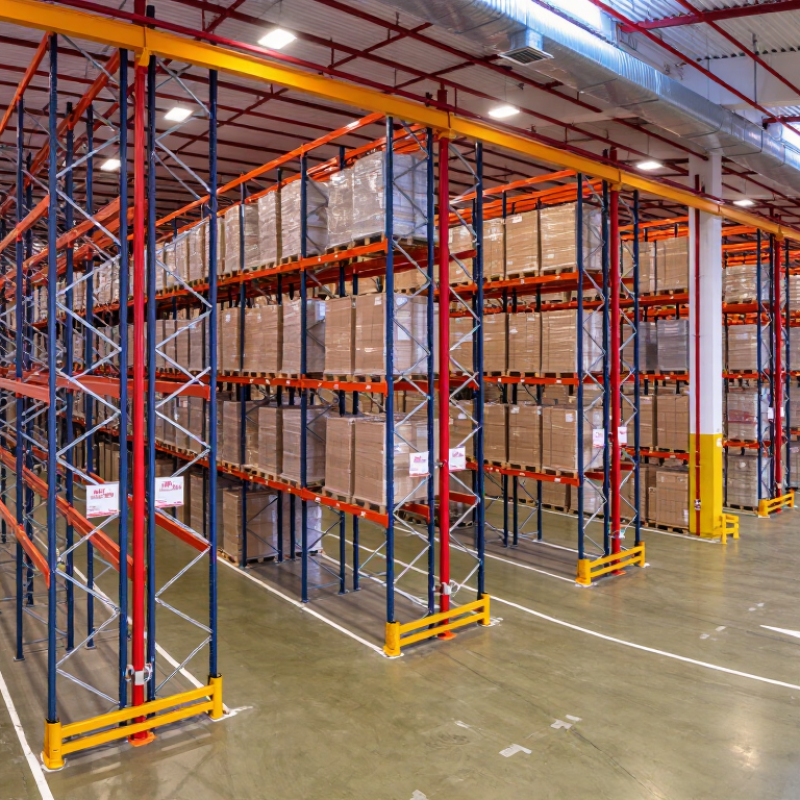
Understand How Heavy-Duty Selective Pallet Racking Works
How to Choose Heavy Duty Selective Pallet Racking
Heavy-duty selective pallet racking stores pallets on horizontal beams fixed between vertical frames. Each pallet remains directly accessible from the aisle. This simple structure supports high SKU variety, but its performance depends on accurate design. The load travels from the pallet to the beams, then through the uprights and baseplates into the concrete slab. Every connection matters.
Measure twice. Do not guess.
Begin with pallet weight, dimensions, load distribution, and the number of storage levels. Confirm beam capacity under uniformly distributed loads, not only the heaviest pallet. A 1,000-kilogram pallet may create unsafe stress when its weight sits near the beam ends. Check clearances for forklifts, sprinklers, lighting, and building columns. Floor quality also deserves attention; uneven slabs can affect frame stability and alignment.
The U.S. Bureau of Labor Statistics reported 4.8 recordable injury cases per 100 full-time workers in transportation and warehousing during 2023. That figure is not a racking statistic, but it reinforces the need for controlled aisles and disciplined inspections. The 2024 MHI Annual Industry Report found that 55% of supply chain leaders planned to increase technology investment. Digital inventory tools can improve slotting, yet they cannot correct overloaded beams or damaged uprights. Operators should inspect frames, anchors, safety pins, and impact guards routinely. I still see layouts chosen by maximum capacity alone. That is a costly shortcut. A practical design balances capacity, access, visibility, and daily human behavior.
| How to Choose Heavy-Duty Selective Pallet Racking — Understand How It Works | |||
|---|---|---|---|
| Selection Factor | How the System Works | What to Check | Practical Guidance |
| Storage configuration | Each pallet is stored in an individual position on a beam level. A forklift accesses pallets directly from the aisle. | Required pallet count, product variety, stock rotation, and access frequency. | Selective racking suits operations that need direct access to many different SKUs. It generally uses more aisle space than higher-density systems. |
| Pallet dimensions and orientation | Beams support the pallet load across the rack bay; the pallet is normally placed with its stringers or deck boards positioned as specified by the rack design. | Pallet length, width, height, condition, overhang, and the direction in which it will be stored. | Measure the actual loaded pallet, not just the empty pallet. Confirm the required beam length and pallet clearances with the rack designer. |
| Load weight | Vertical loads pass from the pallet to the beams, then through the frames and base plates to the floor. | Maximum loaded pallet weight, number of pallet positions per beam level, and total load on each frame. | Use the heaviest expected pallet load. Rated capacities depend on beam span, frame height and depth, bracing, configuration, and installation conditions; do not estimate from a generic figure. |
| Beam levels and bay height | Adjustable beams create storage levels. The lowest beam and level spacing determine how pallets fit vertically. | Ceiling height, sprinkler and lighting clearance, pallet height, forklift lift height, and required vertical handling clearance. | Allow suitable clearance above and between loads for safe placement and removal. Check applicable fire-protection and building requirements. |
| Frame depth and aisle width | Frames support the ends of the beams. Aisles provide the operating space needed for the selected forklift. | Load depth, pallet overhang, forklift type, turning radius, mast height, and operating aisle requirements. | Coordinate rack layout with the forklift supplier and rack designer. Aisle width is equipment- and site-dependent, not a universal fixed value. |
| Forklift and handling equipment | Forklifts place and retrieve pallets from each accessible bay and level. | Truck capacity at the required lift height, load center, mast dimensions, and compatibility with the aisle layout. | Verify the truck’s capacity at the actual lift height and load center; its rated capacity may differ from the capacity shown for lower lifts. |
| Floor and anchoring | Frame base plates transfer rack loads to the floor; anchors help secure the rack against movement. | Slab condition, floor flatness, concrete strength, joint locations, anchor requirements, and local seismic conditions. | Have the floor and anchoring requirements reviewed by qualified professionals. Do not assume an existing slab is suitable without verification. |
| Protection and accessories | Guards and accessories help reduce damage or improve load support when correctly selected and installed. | Forklift impact exposure, pallet condition, load stability, and whether wire decking or other supports are needed. | Consider column guards and other suitable protection in exposed areas. Accessories must be compatible with the rack design and must not be treated as a substitute for rated components. |
| Inspection and maintenance | Regular checks help identify damage, displaced components, missing safety parts, and changes to the original configuration. | Bent or damaged members, loose or missing components, impact marks, load labels, and unauthorized alterations. | Establish a documented inspection and reporting process. Remove damaged areas from service when appropriate and obtain a competent assessment before reuse. |
| Capacity and compliance | Safe capacity is determined by the complete installed system, not by an individual beam or frame in isolation. | Current capacity plaques, approved drawings, local codes, seismic design needs, and any changes in stored loads. | Obtain a site-specific design and load ratings from a qualified rack designer or engineer. Follow applicable local regulations and the rack manufacturer’s technical documentation. |
FAQS
It stores pallets on beams between upright frames. Each pallet remains accessible from the aisle. Simple, but every connection matters.
Record pallet weight, length, width, height, and load stability. Use the heaviest realistic load, not the average. Measure twice.
Confirm capacity for the expected load distribution across each beam. A heavy pallet positioned near beam ends can create unsafe stress.
Bent boards or uneven cartons may shift during placement. A pallet can look fine from the aisle. Check it closely.
Match aisle width to the actual forklift and pallet overhang. Test the layout with floor markings or a scaled drawing. Paper plans can mislead.
Measure clear ceiling height, columns, doors, lights, and sprinkler pipes. Use the lowest obstruction to set usable rack height.
Place fast-moving goods near dispatch areas when practical. Higher levels may suit slower stock, if retrieval remains safe. Peak demand changes things.
Check frames, beams, anchors, safety pins, impact guards, and pallets. Mark each bay with its safe working load. Do not rely on appearance alone.
No. The article’s 2023 injury figure covers transportation and warehousing, not racking specifically. It still highlights the value of controlled aisles and regular inspections.
Conclusion
Choosing Heavy Duty Selective Pallet Racking starts with understanding how the system provides direct access to individual pallet positions, making it suitable for warehouses that need flexible storage and frequent stock rotation. Before selecting a configuration, assess the weight, dimensions, and number of pallets, along with inventory turnover and handling equipment requirements. These details help determine the appropriate rack arrangement and capacity for daily operations.
Next, measure the warehouse carefully and plan aisle widths, clearances, and traffic flow to make effective use of available space. Compare rack materials, load ratings, and safety features, and confirm that the design suits the building and operating conditions. Professional installation and adherence to applicable standards help support reliable use. Finally, consider future changes in inventory or warehouse needs so the system can be adjusted or expanded without disrupting operations.