Featured Heavy-Duty Push Back & High-Density Racking Systems
Standardized cold-rolled Q235B/Q355B steel structures manufactured with precision progressive stamping, automated robotic MIG welding, and calibrated gravity incline channels.
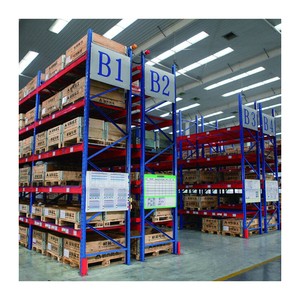 2000kg/Level
Industrial Pallet Racking System Spliced Steel Drop-Over Deck Panel Warehouse Storage Rack 2000kg Heavy Duty
- Structure Profile: Omega Upright 90*70
- Beam Connector: 4-Claw Riveted Interlock
- Deck Plate: Spliced Drop-Over Panel
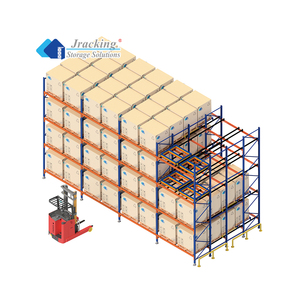 2-6 Deep Carts
Jracking Heavy Loading Adjustable Push Back Racks for Effective Storage Warehouse
- Cart Mechanism: Precision Steel Flanged Bearing
- Track Gradient: 2.8% to 3.2% Controlled Incline
- Stock Logic: FILO High Density
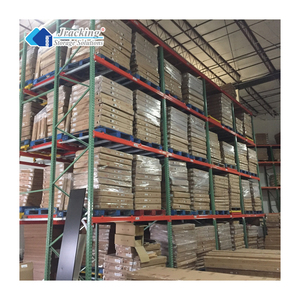 Up to 75% Space
Highly Effective High-density Warehouse Storage System Push Back Racking
- Lane Configuration: 3 to 5 Pallet Depth
- Safety Features: Front Bump Stop & Anti-Lift Catch
- Handling Type: Counterbalance & Reach Truck
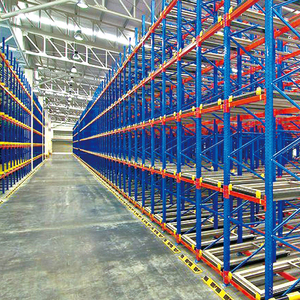 5 Multi-Tier
Reinforced Steel 5 Layer Push Back Pallet Racking Heavy Duty Efficient Goods Picking Warehouse Storage Shelving
- Upright Height: Customized Up to 11.8m
- Corrosion Proof: Dual Powder Coating / HDG
- Seismic Safety: Base Anchor M16 High-Tensile
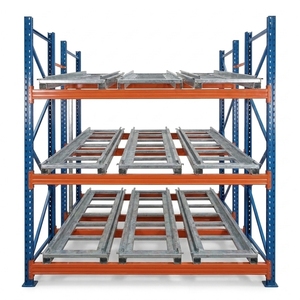 Main Rack 2.0mm
Heavy- Duty Push Back Racking Main Rack 2.0mm, customizable FILO, high space utilization 30 days Delivery Time
- Material Standard: Baosteel High-Yield Q235B
- Lead Time: 30 Days Direct Export
- Pallet Tolerances: GMA, EUR & Non-Standard
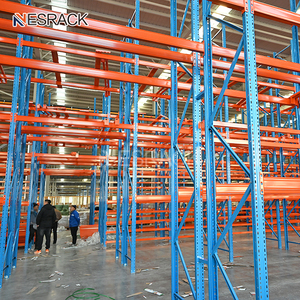 Beam Interlock
Warehouse Heavy Duty 5 Layer Steel Adjustable Selective Pallet Rack Racking System For Sale
- Adjustability: 50mm / 75mm Pitch Pitching
- Capacity: 1000kg - 4500kg per pair beam
- Finish: Electrostatic Epoxy Finish
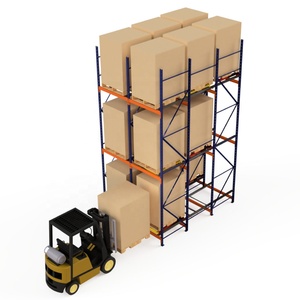 Certified Export
Alibaba Gold Supplier of Steel Heavy Duty Push Back Pallet Rack
- Cold Store Ready: Operational to -30°C
- Cart Rail Profile: Structural Angle 60*40*3.0
- Testing Compliance: SGS/TUV Static Load Certified
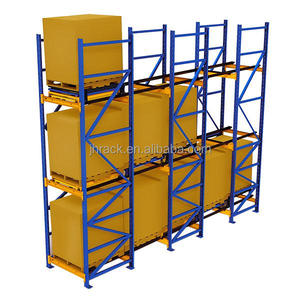 Turnkey Supply
Wholesale Warehouse Racking System Heavy Duty Metal Iron Shelving Warehouse Storage Push Back Push Back Pallet Racking Systems
- Lane Widths: Up to 1500mm Pallet Base
- Rolling Contact: Sealed Dual-Race Bearings
- Packaging: Seaworthy Steel Bundled Strapping
Require a Customized Push Back Lane Layout & Static Calculation Report?
Our structural engineering department generates CAD lane drawings, seismic load validation, and quotation schedules within 24 hours.
Executive White Paper: Global Supply Chain Dynamics & Push Back Racking Engineering
In contemporary intralogistics engineering, warehouse cube utilization and throughput dynamics dictate operational viability. As modern supply chains grapple with escalating industrial land lease costs, corporate logistics directors are forced to re-examine the traditional reliance on selective pallet racking. While selective systems offer 100% immediate pallet access, their floor space footprint efficiency rarely exceeds 40% due to the vast aisle clearance required for counterbalance or reach mast maneuvers.
Heavy duty push back racking systems manufactured by premier Chinese industrial steel fabricators represent the optimal middle ground between pure selectivity and extreme compact storage density. Operating on a First-In, Last-Out (FILO) inventory regime, push-back racking nests nested wheeled carriages atop inclined structural steel structural rail beams. By leveraging gravitational force and forklift push energy, 2-deep, 3-deep, 4-deep, 5-deep, and 6-deep pallet configurations eliminate interior access aisles, boosting volumetric storage density by 60% to 75% without compromising individual lane selectivity.
Storage Topology Comparison: Push Back vs. Alternative High-Density Systems
Selecting the correct intralogistics system requires an objective engineering evaluation of inventory velocity, SKU heterogeneity, capital expenditure, and structural maintenance overhead. Below is an engineering evaluation comparing heavy-duty push-back racking against standard selective, drive-in, and automated radio shuttle systems:
| System Typology | Storage Density | SKU Selectivity | Stock Rotation | Forklift Drive-In Risk | Maintenance & TCO | Ideal Application |
|---|---|---|---|---|---|---|
| Heavy-Duty Push Back | 70% – 75% | 1 SKU Per Lane | FILO (Gravity) | Zero (Aisle Interface) | Very Low (Passive Mechanics) | Medium-velocity SKUs, Cold Storage, Staging Buffers |
| Standard Selective Rack | 35% – 40% | 100% Direct Access | FIFO / FILO | None (Direct Pick) | Minimal | High-velocity, hyper-fragmented SKU profiles |
| Drive-In / Drive-Through | 65% – 75% | 1 SKU Per Bay | Strict FILO / FIFO | High Severity (Inside Upright) | Moderate to High | Homogeneous seasonal commodities, low-SKU runs |
| Electric Radio Shuttle | 80% – 85% | 1 SKU Per Channel | Automated FIFO / FILO | Zero (Robot Transits Lane) | High (Batteries, Sensors, PLC) | Massive volume FMCG, fully automated multi-deep lanes |
Kinematic Mechanics: The Physics of Multi-Deep Nested Cart Systems
The operational reliability of a heavy-duty push-back system hinges upon rigorous kinematic calculation and structural tolerance controls. Unlike roll-formed pallet flow systems that utilize multiple rows of dynamic skate wheels or poly-rollers across the full bay length, nested cart push-back mechanisms operate via a cascading series of low-profile steel trolleys riding on a pair of inclined structural guide tracks.
Gravitational Slope Gradient
Tracks are calibrated at an exact incline between 2.5% and 3.2% (approx. 1.5° to 1.8°). This gradient generates sufficient kinetic roll force to overcome static bearing friction, while preventing unbraked pallet acceleration during unassisted front staging.
Telescoping Nesting Geometry
Each tier of carriage cart nests telescopically beneath subsequent levels. In a 4-deep configuration, Cart 1 rests on Cart 2, Cart 2 on Cart 3, and Cart 3 on Cart 4. The initial front pallet sits directly on Cart 1; the final rear pallet rests directly upon the structural steel rails.
Anti-Derailment & Lift Catches
Integrated mechanical safety stops, carriage interlocking flanges, and front impact arrestors ensure carts cannot decouple or lift off track channels when struck by misaligned forklifts or asymmetric pallet loads.
When loading a push-back lane, the forklift operator positions the first pallet onto the top nested cart. When the second pallet is introduced, the operator gently pushes the first pallet backward, exposing the underlying second cart. This cycle repeats up to 6 pallets deep. When picking, the operator extracts the front pallet; the remaining trailing carts roll smoothly forward via gravity to the front aisle stop face under controlled velocity. Because forklifts never enter the rack matrix, structural rack impact damages are reduced by over 80% compared to drive-in rack configurations.
Metallurgical Formulations & Manufacturing Engineering Benchmarks
A critical consideration for international procurement teams sourcing from China is the verifiable verification of raw material integrity and roll-forming tolerances. Chinese heavy-duty push-back exporters utilize high-tensile hot-rolled strip steel sourced from certified global steel mills (such as Baosteel, Ansteel, and Shougang).
1. High-Yield Q235B and Q355B Mechanical Properties
Upright upright frame columns and primary structural load-supporting crossbeams are fabricated using either Q235B (Yield Strength ≥ 235 MPa, Tensile Strength 370-500 MPa) or high-strength Q355B (Yield Strength ≥ 355 MPa, Tensile Strength 470-630 MPa). Upright frame sections feature a patented 11-fold to 13-fold profile geometry that resists complex torsional buckling and lateral sway under seismic excitation.
2. Cold-Roll Forming & Robotic MIG Welded Carriages
Tolerances in push-back rack carriages must be controlled within ±0.5mm across diagonal axes to avoid wheel-binding friction inside the tracks. Leading Chinese exporters utilize continuous CNC roll-forming lines coupled with 6-axis robotic welding cells for cart frame assembly. Each carriage is fitted with heavy-duty, sealed-for-life spherical roller bearings encased in machined steel housings.
3. Dual-Layer Electrostatic Powder Coating & Galvanizing
Corrosion mitigation is achieved via an automated 7-stage pre-treatment wash (including zinc phosphate dipping) followed by an electrostatic thermo-hardened epoxy powder coating cured at 200°C. This guarantees a coating thickness of 70–90 microns with cross-hatch adhesion tested to ASTM D3359 Class 5B. For sub-zero cold room environments, cart frames and track channels can be supplied with continuous Hot-Dip Galvanizing (HDG) to EN ISO 1461, yielding coating thicknesses exceeding 65 microns for decades of rust-free duty at -30°C.
Future Procurement Trends: Where High-Density Storage Is Headed (2025–2030)
As global supply chains navigate labor scarcity, land constraints, and energy efficiency mandates, the procurement of push-back racking is undergoing significant structural shifts:
1. Escalation of Cold Chain Demand: Refrigerated and blast-freezer distribution centers represent the fastest-growing sector for push-back installations. Cold storage spaces cost 3x to 5x more to build and cool than ambient warehouses. Sourcing heavy-duty 4-deep and 5-deep push-back systems compresses cold-room cubic volume requirements by 40%, delivering exponential ROI through reduced compressor energy runtimes.
2. Interfacing with AMR and Autonomous Reach Trucks: Leading Chinese manufacturers are refining cart track entry chamfers, pallet positioning reflective targets, and micro-switch stop sensors to interface seamlessly with Autonomous Mobile Robots (AMRs) and automated laser-guided narrow-aisle trucks (AGVs). This unlocks lights-out automated operation inside dense push-back channels.
3. Low-Carbon Steel & ESG Procurement Verification: European and North American buyers increasingly demand Environmental Product Declarations (EPDs) and Life Cycle Assessments (LCAs). Tier-one Chinese exporters are actively adopting electric arc furnace (EAF) recycled scrap steel and zero-discharge powder coating lines to comply with impending Carbon Border Adjustment Mechanism (CBAM) regulations.
Why Global Procurement Leaders Partner with Our Chinese Manufacturing Base
Over 25 years of specialized export engineering, 12 specialized production workshops, and turnkey intralogistics supply chains spanning 70+ countries.
Direct Manufacturer Pricing
Eliminate intermediary trading margins. Sourcing directly from our integrated roll-forming and welding facilities unlocks wholesale factory-gate pricing with full design transparency.
Rigorous Quality Assurance
Every batch undergoes destructive coupon tensile testing, carriage bearing fatigue validation, and 100% full-lane physical trial assembly prior to seaport container containerization.
High-Cube Freight Optimization
Our nesting cart geometry and interlocking pallet beam profiles are designed for maximum 40ft High-Cube container volume packing, cutting overseas sea-freight costs per pallet location by up to 28%.
Frequently Asked Technical Questions (FAQ)
Detailed engineering answers addressing structural safety, operating tolerances, floor flatness, and containerized export handling.
What is the maximum practical lane depth for a heavy-duty push-back racking system?
How much vertical bay clearance is lost due to the nested cart stack?
Can push-back racking accommodate damaged, weak, or non-standard wooden pallets?
What international engineering standards govern your structural export designs?
How do your systems perform in low-temperature cold storage (-25°C to -30°C)?
What are the lead times and container loading specifications for overseas export orders?
Partner with China's Premier Push Back Racking Exporter
Whether you are designing a greenfield cold storage distribution facility or retrofitting an existing warehouse for higher pallet density, our structural engineers are ready to draft your complete layout schedule, 3D visualization, and FOB/CIF/DDP quotation.