Featured Industrial Racking & Material Handling Systems
Manufactured in ISO 9001, CE, and FEM compliant facilities. Engineered for maximum storage density, structural longevity, and seamless forklift/shuttle integration across high-throughput industrial facilities.
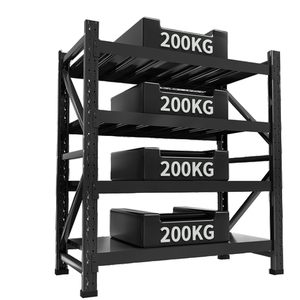
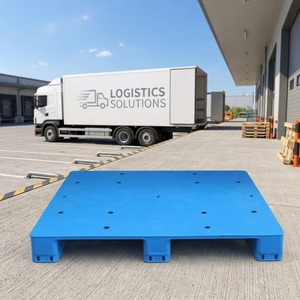
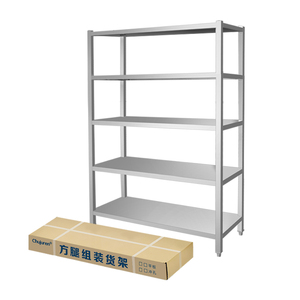
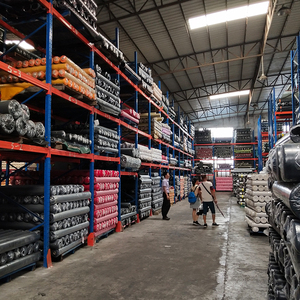
Engineering Whitepaper: The Mechanics and High-Density Kinematics of Drive-In Pallet Racking
In modern supply chain intralogistics, warehouse square footage represents an escalating recurring expenditure. As a premier China industrial drive-in pallet racking manufacturer and exporter, our engineering department provides precision-calculated storage configurations engineered to maximize volumetric utilization by up to 80% compared to conventional selective pallet racks.
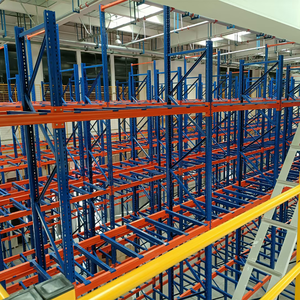
Drive-In racking operates on the Last-In, First-Out (LIFO) or First-In, First-Out (FIFO through Drive-Through architecture) kinematic principle. By eliminating operational access aisles and permitting counterbalanced or reach forklifts to drive directly into the racking depth lanes, the facility converts previously wasted corridor volume into active storage density. Pallets are supported continuously on cantilevered side brackets and continuous one-piece formed support rails, eliminating traditional crossbeams.
| Structural Parameter | Standard Commercial Grade | Our Heavy-Duty Export Grade (Q355B Steel) | Operational Value Advantage |
|---|---|---|---|
| Steel Grade Standard | Commercial Q235A / Low Carbon | Certified Structural Q355B / High Yield | 35% higher tensile strength under dynamic forklift impact |
| Pallet Load Capability | 500 kg - 1,000 kg / pallet | Up to 1,800 kg / pallet location | Accommodates dense chemical, beverage & cold-store loads |
| Column Upright Pitch | 75 mm welded fixings | 50 mm / 75 mm Adjustable Precision Holes | Flexible vertical optimization with minimal vertical waste |
| Surface Protection | Manual Spray < 50μm | Automated Electrostatic Epoxy Powder (80-110μm) | Ultra-durable, salt-spray tested, stable at -30°C cold room |
| Seismic Compliance | Not explicitly rated | FEM 10.2.02, EN 15512, RMI Standards | Engineered top & back bracing resisting seismic drift |
Structural safety within drive-in bays requires rigorous calculation. Because forklift operators enter the racking footprint, the risk of column deflection from fork truck mast contact is inherently higher. Our structural designs integrate heavy-gauge floor-anchored ground guide rails, flared column impact protectors with 12mm baseplates, and continuous double-welded spine bracing to absorb dynamic impact and prevent structural resonance.
Future Procurement Trends & Technological Evolution in High-Density Storage
Global supply chain leaders and distribution centers are rapidly modernizing their handling operations. When assessing long-term procurement budgets for heavy-duty industrial racking from China, procurement directors must evaluate several transformative technological trends shaping intralogistics:
1. Migration to Semi-Automated Radio Shuttle Systems
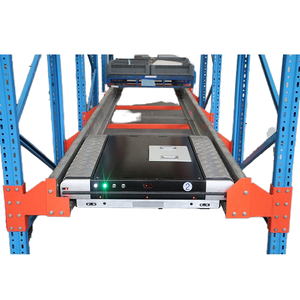
Traditional drive-in racking requires forklifts to physically enter the lanes, increasing transit time and pallet cycle latency. The contemporary trend merges drive-in lane structure with Radio Shuttle carriers. Forklifts stay in the main corridor, while independent battery shuttles retrieve loads, doubling throughput speed and eliminating rack collision risks.
2. Cold Chain & Energy Densification Requirements
With refrigerated warehouse energy costs continuing to rise globally, maximizing thermal cubic efficiency is a primary driver. High-density drive-in and automated compact racking reduce cooling energy loss per pallet position by over 40%, driving immense ROI for food logistics, frozen goods, and pharmaceutical exporters.
3. Digital Twin Modeling & Finite Element Analysis
Modern international buyers now demand Finite Element Method (FEM) simulation before metal cutting begins. Engineering drawings are simulated against regional wind loads, soil seismic zones, and operational cycle frequencies to guarantee structural certifiability under local building codes (such as IBC, Eurocode 3, and AS4084).
Our Core Manufacturing & Global Export Advantages
Backed by over 60 years of technical expertise in material storage engineering, our production facilities and service operations ensure total process reliability from raw structural coil through to on-site assembly overseas.
60 Years Heritage
Decades of industrial mastery delivering specialized static, mobile, and automated storage solutions across global continents.
70+ Global Markets
Extensive international logistics, standard packaging, and container loading experience delivering safely to sea ports worldwide.
12 Production Centers
Fully automated roll-forming lines, robotic continuous welders, and Swiss GEMA automated powder coating systems ensuring high precision.
End-to-End Lifecycle
Comprehensive layout CAD design, static calculations, third-party certs, modular spares supply, and post-installation technical support.
Frequently Asked Questions: Industrial Pallet Racking Procurement
Clear engineering answers to critical inquiries raised by global procurement directors, warehouse operations consultants, and facility architects prior to tender contracting:
What factors determine whether Drive-In Racking is superior to Selective Pallet Racking?
What essential data is required to generate an accurate layout proposal and price quotation?
How does your factory protect upright columns against forklift collisions inside drive-in lanes?
Can Drive-In Racking be deployed in sub-zero cold room environments?
What international testing standards and load-bearing certifications do your systems satisfy?
Optimize Your Facility Cubic Capacity Today
Speak directly with our senior intralogistics structural engineers. We provide comprehensive CAD layout schematics, pallet clearance modeling, dynamic load calculations, and turnkey factory-direct export proposals tailored to your specific building dimensions.