Engineered Catalog
High-Performance Industrial Racking & Storage Modules
Direct manufacturer supply for certified warehouse configurations, long-span profiles, automated shuttle channels, and space-saving nested solutions.
60+
Years Engineering Heritage
70+
Export Nations Served
12
Specialized Production Hubs
100%
FEM / RMI Safety Compliant
Technical Insight
Engineering Structural Integrity: Nesting Racks & Stacking Systems
Why modern global supply chains are replacing static structures with heavy-duty portable nesting and modular racking architectures.
Dynamic Return-Ratio Optimization
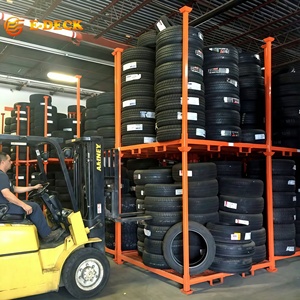
Standard fixed-post racking creates permanent volumetric voids during freight lulls. Nestable pallet and tire racking utilize engineered conical post cups and flared base profiles, achieving up to a 4:1 reverse-logistics nesting density ratio. This dramatically slashes dead-haul transportation expenses across long-distance intermodal logistics.
Q235B & Q355B Steel Metallurgical Standards
Our direct manufacturing hubs prioritize high-yield cold-formed structural steel. Every weld seam is executed through automated submerged-arc and robotic MIG cells, ensuring complete load redistribution under rigorous seismic forces, dynamic forklift impacts, and concentrated static payloads up to 2,000 kg per nest tier.
High-Durability Surface Metallurgy
From automated multi-stage iron-phosphate pretreatments to hot-dip galvanization and electro-deposition thermoset powder coating (60–90µm), our finishes withstand extreme humidity, deep-freeze cold storage environments down to -30°C, and abrasive industrial handling environments without surface delamination.
Strategic Sourcing
Future Procurement Trends in Industrial Nesting Systems
Critical structural shifts B2B supply chain executives and operations directors must evaluate through 2026–2030.
Decoupling Fixed Infrastructure via Modular Racks
Rising industrial real estate lease costs are forcing 3PL operators and enterprise manufacturing centers away from anchored, unchangeable floor tracks. Portable, heavy-duty nesting frames allow dynamic footprint reallocation: peak-season bulk stacking transforms into open buffer zones within minutes, mitigating long-term civil construction commitments.
Total Cost of Ownership (TCO) vs. Spot Unit Price
Global procurement teams are moving beyond FOB container price quotes. Leading supply chain buyers run comprehensive life-cycle assessments calculating frame replacement rates, steel yield certifiable longevity, stack reliability (avoiding costly inventory collapses), and nesting ergonomics that minimize warehouse forklift cycle times.
ESG Accountability & Low-Carbon Steel Supply Chains
Export compliance mandates (such as the EU's CBAM carbon tracking mechanism) require tier-one suppliers to declare emissions per metric ton of steel manufactured. Chinese manufacturing leaders are pairing green electric-arc furnace (EAF) steel sourcing with volatile organic compound (VOC)-free thermoset coatings to support clients' Scope 3 reduction goals.
Engineering Horizon
The Technological Evolution of Industrial Warehouse Nesting
The transition from manual cold-rolled framing to digitally unified, robotics-compatible intralogistics structures.
IoT-Enabled Dynamic Telemetry
Next-generation nesting racks are incorporating passive UHF RFID transponders and integrated BLE beacons into welded corner cavities. This provides automated pallet identification during forklift passage through portal scanners, feeding real-time positional data directly into ERP and Warehouse Management Systems without human barcode scanning.
Precision Tooling for AMR & AGV Pick Interfaces
As autonomous mobile robots (AMRs) replace manual counterbalanced forklifts, dimensional tolerances on nesting base skids are narrowing from ±3.0mm to less than ±0.75mm. CNC tube laser profiling and robotic fixture jigging ensure uniform ground-clearance windows for automated under-deck lifting platforms.
Hybrid Finite Element Analysis (FEA) Modeling
Advanced CAD stress simulations now replicate real-world multi-axis dynamic loads encountered during high-density stacking. By predicting deflection points and local buckling under non-uniform loads, engineers optimize steel wall thicknesses—reducing unnecessary dead weight while reinforcing load-bearing gussets.
Enterprise Strengths
Why Tier-1 Global Enterprises Choose Our Manufacturing Ecosystem
Leveraging 60 years of intralogistics pedigree, 12 intelligent manufacturing centers, and dedicated structural R&D divisions.
In-House Calculation & FEM Compliance
We do not guess structural thresholds. Our internal structural design institute conducts independent calculation notes adhering strictly to EN 15512 (European Racking Code), AS 4084 (Australian Standard), and American RMI specifications to ensure unconditional safety and permitting approval globally.
Integrated 12-Center Production Network
Direct ownership of large-scale roll-forming lines, computerized tube punching lines, and continuous powder-coating tracks ensures strict vertical quality control. By eliminating outsourced intermediaries, we guarantee continuous steel batch traceability from mill test certificate (MTC) to final shipping container.
Turnkey Engineering & Global Integration
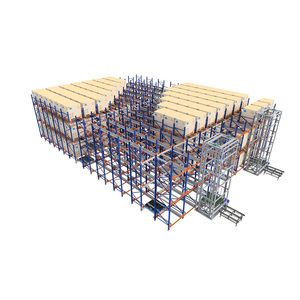
Beyond metal fabrication, we bridge the gap between static steel and intelligent automation. With 7 dedicated R&D software and robotics labs, our technical teams integrate nesting storage modules seamlessly with WMS software, conveyor systems, and 4-way shuttles deployed across more than 70 countries worldwide.
Buyer Knowledge Base
Frequently Asked Questions: Heavy Duty Nesting & Storage Procurement
Detailed technical, engineering, and commercial answers for warehouse planners, operations directors, and logistics buyers.
What are the key technical criteria for specifying load capacity in nesting racks?
Specifying dynamic and static load capacity requires an assessment of: individual pallet weight distribution, stacking tier height (e.g., 3-high, 4-high, or 5-high stacks), forklift shock coefficients, and ground floor slab bearing strength. Nesting racks undergo rigorous finite element modeling to determine both yield strength under full uniform distributed load (UDL) and point-load resistance at the base cup contact joints. Load limit placards should be calculated per unit and prominently affixed to each frame.
How does nesting rack return efficiency optimize reverse logistics in shipping?
Unlike rigid pallet racking that requires complete mechanical disassembly or welded non-collapsible cages that consume full truckload volume when empty, precision-engineered nesting racks feature angled structural bases. When unloaded, the base of one rack slides seamlessly into the base of another, allowing up to 3 to 4 nested units to occupy the footprint of a single assembled unit. This delivers a substantial reduction in empty freight volume during plant-to-warehouse loops or seasonal consolidation.
Which surface treatment is recommended: Powder Coating or Hot-Dip Galvanization?
Selection depends on operational environment: Electrostatically applied thermoset epoxy-polyester powder coating (60–90µm thick) is ideal for standard indoor ambient dry warehousing, offering high abrasion resistance, color categorization, and lower cost. For extreme environments—such as sub-zero cold storage facilities with condensation cycling, outdoor distribution yards, or chemical exposure—hot-dip galvanization conforming to ISO 1461 is mandatory to provide comprehensive galvanic sacrificial protection against corrosion.
Can custom nesting racks be integrated with Automated Guided Vehicles (AGVs) or AMRs?
Yes. Modern intralogistics frequently integrates heavy-duty nested bases with AMR lifters and automated towing AGVs. This integration requires strict manufacturing tolerances on base fork pockets, optical reflector pin locations, and ground clearance uniformity (tolerances maintained within ±1mm). Custom alignment tabs and floor-docking sensors can be engineered into the structural base frame during OEM fabrication to facilitate autonomous docking.
What documentation and structural verification should buyers require from China factories?
Professional B2B buyers must demand: Mill Test Certificates (MTC) verifying raw material chemical and tensile properties (Q235B/Q355B), structural weld quality inspection reports, third-party static deflection load test certifications, and verified compliance with regional codes such as EN 15512 or ANSI MH16.1. Furthermore, factory audits certifying ISO 9001 quality management, ISO 14001 environmental compliance, and CE mark conformity should be validated prior to contract finalization.
What are the lead times, packaging methods, and container loading protocols for overseas transit?
Standard OEM production cycles range from 20 to 35 days depending on tonnage and tooling customization. Packaging uses heavy-duty steel strapping, stretch-film wrapping, and custom timber dunnage blocks at nesting touchpoints to prevent maritime friction damage. Container stuffing plans (utilizing 40ft High Cube containers) are digitally modeled to maximize volumetric utilization while ensuring safe mechanical discharge via counterbalanced forklift tines at destination ports.
Accelerate Your Intralogistics Efficiency Today
Consult with our senior structural engineers for tailored warehouse layout simulations, load capacity calculations, and custom OEM/ODM nesting rack quotations.