Engineering Structural Resilience in Automated High-Bay Racking
A rigorous examination of metallurgy, kinetic tolerances, structural engineering, and procurement dynamics in next-generation automated intralogistics.
Modern intralogistics has shifted irreversibly from static storage infrastructure to highly dynamic, integrated material handling networks. Warehouse managers, supply chain directors, and EPC procurement executives face unprecedented pressure to maximize volumetric utilization while accelerating cycle throughput. As facilities expand vertically—frequently exceeding 40 meters in clad-rack and high-bay configurations—the structural engineering of heavy-duty pallet racking ceases to be a rudimentary steel commoditization and becomes a core structural engineering discipline.
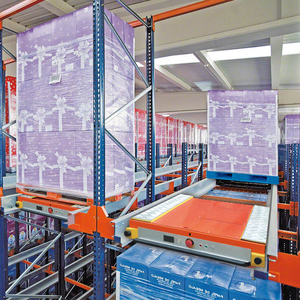
"The integration of autonomous robotic systems, automated stacker cranes (AS/RS), and four-way radio shuttles eliminates operational variance while exerting unique dynamic harmonic stresses on the steel matrix. Structural deflection tolerances that pass muster in conventional forklift facilities will cause catastrophic optical sensor misalignment or mechanical jamming in high-speed automated storage environments."
Structural Metallurgy and Cold-Rolled Forming Tolerances
The foundation of automated racking reliability lies in cold-rolled steel profiling. OEM custom manufacturing demands certified structural steels—predominantly high-tensile Q235B, Q355B, or equivalent EN 10025 structural grades—formed under precision multi-stage roll-forming lines. The mechanical integrity of upright columns and load-bearing horizontal beams is calculated using non-linear finite element analysis (FEA) to account for torsional buckling, second-order P-Delta gravitational effects, and cyclic loading fatigue.
In high-density radio shuttle racks and automated miniload installations, horizontal beam deflection is constrained to strict thresholds (typically 1/200th to 1/300th of the span, and tighter than 1/400th in crane-interfaced AS/RS systems). Automated systems require tighter deflection limits compared to the standard 1/150th accepted under basic manual storage codes (FEM 10.2.02 or RMI specifications). In addition to deflection limits, precision punch hole pitch (often 50mm or 75mm continuous matrix) enables precise beam level adjustments, optimizing vertical clearances down to the millimeter to maximize SKU storage density.
Finite Element Stress Optimization
Every profile undergoes advanced computer-aided stress distribution modeling to ensure joint structural integrity under extreme dynamic deceleration, seismic acceleration, and maximum asymmetrical pallet weights.
Hot-Dip Galvanized & Epoxy Duplex
Superior surface treatments provide robust anti-corrosive protection across harsh operating envelopes, from deep sub-zero cold-chain freezers (-30°C) to corrosive chemical environments and humid ambient warehouses.
WCS/WMS Automation Interface
Engineered to exact geometric tolerances that enable instant synchronization with Warehouse Control Systems (WCS), high-speed cranes, laser positioning systems, and autonomous mobile transport units.
Technical Comparison: Static Racking vs. High-Density Automation Systems
Selecting an optimal warehouse architecture requires a transparent assessment of volumetric density, capital outlay, stock rotation, and dynamic handling equipment. The following engineering matrix presents clear performance benchmarks for primary industrial storage configurations:
| System Architecture | Space Utilization | Pallet Selectivity | Rotation Principle | Handling Equipment Compatibility |
|---|---|---|---|---|
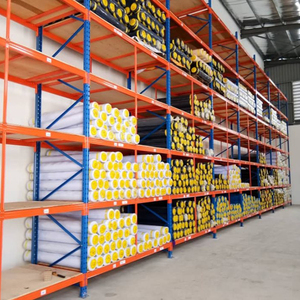
| Selective Pallet Racking | Baseline (40% - 50%) | 100% Direct Access | FIFO / LIFO Adaptive | Counterbalance, Reach Trucks, VNA |
| Radio Shuttle High-Density | High (70% - 85%) | Lane Selective (LIFO/FIFO) | Optimized Batch Flow | Semi-Automated Shuttles + Forklifts |
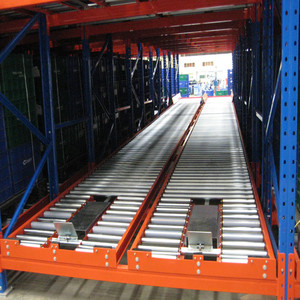
| Gravity Flow Roller Systems | High (75% - 80%) | Strict Lane Access | Strict Physical FIFO | Standard Forklifts, Conveyor Feeders |
| AS/RS Stacker Crane High-Bay | Maximum (85% - 95%+) | 100% Automated Access | Software-Driven FIFO | Automated Stacker Cranes, Conveyor Loops |
| Clad-Rack Structural Building | Absolute Maximum | Dynamic Optimized | Integrated WCS/WMS | Fully Automated Monorail, AMRs, Cranes |
Future Procurement Trends: The Next Horizon in Pallet Racking
Procurement strategies for heavy-duty racking systems are undergoing a paradigm shift driven by macroeconomic forces, urbanization, and labor market realignments. In evaluating suppliers for capital projects over the next five to ten years, cross-functional buying committees prioritize the following developments:
Pre-Engineered Clad-Rack Systems
Escalating industrial land costs and lengthy permitting cycles are accelerating the adoption of clad-rack buildings. By utilizing the racking matrix as the primary load-bearing structural support for exterior walls and roofs, organizations save up to 25% in capital costs while compressing construction schedules.
Hybrid Robotics Compatibility (AMRs & Shuttles)
Procurement teams demand physical racks that support modular retrofits. Fleets of Autonomous Mobile Robots (AMRs) and 4-way deep-lane pallet shuttles are replacing rigid conveyor lines, requiring racking base profiles engineered with millimeter-flat run tracks and integrated sensor brackets.
Digital Twin Modeling & Lifecycle Auditing
Forward-thinking operators now require full Building Information Modeling (BIM) files (Level of Detail 300 to 400) prior to steel fabrication. Suppliers must deliver digital twins to simulate dynamic stacker crane interaction, analyze thermal variations, and streamline automated maintenance protocols.
OEM Engineering Authority: Why Industry Leaders Partner With Us
With an international engineering pedigree backed by six decades of intralogistics innovation, we manufacture customized storage solutions engineered to individual customer load profiles, seismic parameters, and throughput targets. Rather than supplying catalog-standard racking, our in-house metallurgical engineers and material handling consultants deliver tailored industrial infrastructure.
Global Manufacturing Reach & Complete Lifecycle Governance
Operating through a proven manufacturing infrastructure spanning 12 worldwide production facilities and 7 state-of-the-art R&D engineering laboratories, our enterprise delivers end-to-end quality control from raw steel coil slitting to precision roll-forming and robotic welding.
- ISO 9001, CE, & EN 15512 Certified
- 100% In-House Structural Calculation
- Automated Powder Coating Lines
- High-Precision Seismic Engineering
Our comprehensive service ecosystem covers everything from preliminary 3D simulation and structural layout calculations to professional on-site installation, proof-load testing, and annual safety inspection certifications. Global multi-facility clients benefit from cross-border project management with localized compliance across North America, Europe, Latin America, and the Asia-Pacific region.
Whether you require standard 1,000 kg capacity selective pallet racks, heavy-duty 5,000 kg die-storage configurations, or fully automated clad-rack warehouses managed by integrated WMS/WCS software platforms, our turnkey engineering ensures high durability and continuous operation.
Frequently Asked Questions on Pallet Racking Procurement
Key technical, structural, and commercial questions addressed by our senior systems engineers.