Industrial Storage & Heavy Duty Heavy-Bay Racking Systems
Manufactured from structural grade Q235B/Q355 cold-rolled steel, engineered to meet rigorous FEM 10.2.02 and RMI specifications with surface electrostatic epoxy powder finish.
Top 10 Heavy Duty Warehouse Storage Manufacturers & Selection Criteria
A technical assessment for enterprise buyers evaluating European engineering standards, high-throughput automation suppliers, and North American logistics footprints.
Navigating the international landscape of heavy-duty industrial storage equipment demands deep technical discernment. Major global intralogistics providers such as Mecalux, SSI Schaefer, Daifuku, Dematic, Vanderlande, Interlake Mecalux, Dexion, Jungheinrich, Stow Group, and Swisslog represent the upper echelon of structural manufacturing and automation control. Enterprise procurement engineers must assess factories not solely on raw steel tonnage price, but across beam deflection tolerances (e.g., L/200 under maximal dead-and-live loads), structural connection integrity, earthquake zone dampening profiles, and integrated WMS/WCS software stack compatibility.
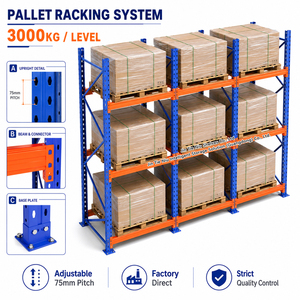
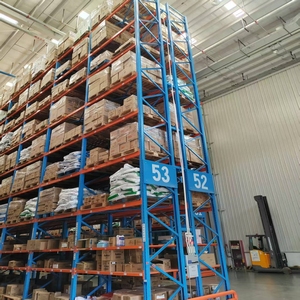
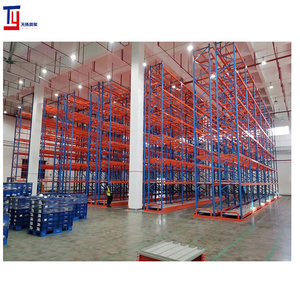
A superior warehouse manufacturer combines in-house cold roll-forming capabilities with finite element analysis (FEA) structural verification. When heavy pallets weighing between 1,000kg to 3,000kg are stacked vertically up to 40 meters, metallurgical quality (such as Q355 or ASTM A1011 Grade 50) directly dictates overall facility life-cycle safety and insurance risk premiums.
| Storage Topology | Volumetric Density | Selectivity Profile | Throughput Velocity | Ideal Logistics Scenario |
|---|---|---|---|---|
| Selective Pallet Racking | Moderate (35%-40% cube utilisation) | 100% Direct SKU Accessibility | High (Manual / Counterbalanced) | Omni-channel distribution, high SKU divergence, 3PL logistics facilities. |
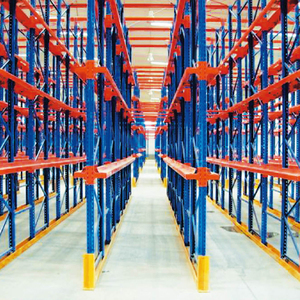
| Drive-In / Drive-Through | High (65%-75% cube utilisation) | Lane-based (FILO / FIFO) | Low to Medium (Forklift internal travel) | Cold storage, frozen warehousing, homogeneous raw ingredient batching. |
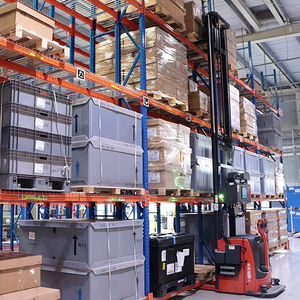
| Pallet Shuttle & Radio Shuttles | Ultra-High (up to 85% cube utilisation) | Deep-Lane Automated Retrieval | High (Automated battery carrier) | Beverage bottling plants, FMCG buffers, deep freeze distribution centres. |
| ASRS Stacker Crane Systems | Maximal (Vertical up to 45m) | 100% Computerized Access | Continuous 24/7 Automated Flow | Automotive Tier-1 assembly supply, massive pharmaceutical reserves. |
Future Procurement Trend: Robotic Interoperability
Buyers are systematically decoupling traditional manual racking from static floorplans. Modern tender specifications demand racking feet profiles and floor tolerances (VDI 2653 / DIN 15185) built ready for Autonomous Mobile Robots (AMRs), automated 4-way shuttles, and vision-guided AGVs.
Industrial Evolution: Clad-Rack Engineering
Rather than erecting an industrial warehouse building and subsequently installing shelving inside, modern greenfield logistics sites adopt rack-supported clad buildings. Racking structures directly sustain the roof and side-wall cladding, slashing capital real estate expenditure by 25-35%.
Digital Twin & Predictive Structural Integrity
Next-generation racking leverages IoT impact telemetry and strain gauges integrated into the base uprights. Software platforms mirror beam load dynamics in real time, alerting facilities directors to dangerous micro-deflections or undetected forklift collisions before systemic failure happens.
Why Tier-1 Global Supply Chains Partner With Us
Combining 60 years of structural pedigree with continuous innovation across 70+ countries.
Direct Production Scale
Our 12 international production centres feature continuous CNC automated cold-roll profiling lines, laser cutting, and certified robotic welding cells, assuring tight dimensional control and resilient supply continuity worldwide.
Gartner® Magic Quadrant™ WMS
Recognized five consecutive times in the Gartner Magic Quadrant for WMS, our proprietary Easy WMS, WES, and WCS suite bridges physical steel with real-time enterprise ERP systems, eliminating 99% of fulfillment picking errors.
End-to-End Lifecycle SLA
From initial seismological layout calculation and floor-slab anchoring studies through installation, annual EN 15635 rack safety inspections, and on-demand component replacement, our global engineering offices deliver guaranteed support.
Frequently Asked Questions on Heavy-Duty Racking Procurement
Critical structural, compliance, and design queries answered by certified intralogistics project engineers.
How is the maximum permissible load capacity calculated for pallet racking?
What specific warehouse building data is needed before drafting an engineering proposal?
Can existing selective racking be retrofitted for automated pallet shuttles or AMRs?
What are the key differences between cold-rolled steel and structural steel racking?
How does warehouse management software (WMS) interface with automated storage hardware?
Design Your Custom Heavy-Duty Warehouse System Today
Consult with our qualified structural and intralogistics engineers for a complimentary layout review, static load analysis, and competitive manufacturing budget.