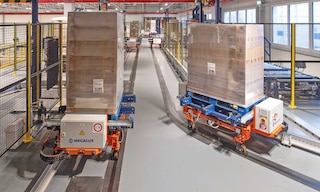
Electric Monorail System (EMS): Heavy-Duty Overhead & Inverted Rail Automation
Engineered to bypass floor congestion, accelerate cycle times, and link multi-facility manufacturing workflows at travel speeds up to 300 m/min.
Connecting AS/RS Buffers to High-Speed Dispatch Loops
Precision-guided self-propelled carriers synchronised seamlessly with stacker cranes, miniload units, and production lines.
Intelligent Zone Blocking & Collision-Free Dynamic Dispatch
Centralized Easy WCS integration with distributed on-carrier fail-safe PLCs for ultra-reliable 24/7 continuous throughput.
MECALUX RACKING: Engineering Authority in Electrified Monorail Logistics
Modern supply chains and gigafactories face high throughput bottlenecks that conventional floor-bound conveyors or AGVs cannot solve alone. MECALUX RACKING delivers turnkey Electric Monorail Systems (EMS) engineered to exploit building vertical volume, eliminate floor cross-traffic, and handle extreme duty cycles across 70+ countries worldwide. With over 60 years of structural calculations, 12 production facilities, and 7 specialized R&D centres, we design, manufacture, and commission every track switch, hoist section, and autonomous carrier directly to European and international safety standards.
Engineered Electric Monorail Systems for Industrial Demands
From delicate cleanroom electronic sub-assemblies to heavy-duty automotive engine skids and palletised beverage blocks, MECALUX RACKING tailors EMS vehicle kinematics and profile rails to your exacting manufacturing throughput.
Overhead Heavy-Duty Pallet EMS
Suspended high-capacity monorail systems engineered for transferring loaded Euro, ISO, and industrial slip-sheet pallets (up to 3,200 kg) between distant warehouse bays and shipping docks.
- Travel speeds up to 200 m/min with smooth S-curve ramp profiles
- Integrated electric hoist lifters for bi-level ceiling and floor interconnections
- Rugged conductor busbars with low-wear dual graphite current collectors
Inverted Floor-Mounted Monorail (IF-EMS)
Floor-anchored rail platforms engineered for automotive assembly loops, EV battery pack staging, and clean environments requiring zero overhead drippage and unobstructed ergonomic access.
- Variable ergonomic scissor-lift indexing for synchronous manual assembly
- Whisper-quiet vulkollan-tired guide wheels emitting under 65 dBA sound
- Ultra-clean encapsulated rail profiles eliminating dust and friction emissions
High-Speed Tote & Carton EMS (Light Goods)
Rapid-acceleration monorail carriers designed for e-commerce, pharmaceutical fulfillment, and tote distribution loops reaching line velocities up to 300 m/min with ultra-dense multi-track sorting switches.
- High cycle rates exceeding 1,200 totes per hour on continuous multi-loop tracks
- Decentralized smart optical distance sensors for precision dynamic buffering
- Zero ground footprint to maintain absolute facility walkway clearance
Easy WCS & Smart Carrier Fleet Orchestration
Our intelligent software layer coordinates multiple monorail carriers dynamically across complex track networks, managing high-speed track switches, buffer queues, and AS/RS handoffs.
- Real-time telemetry tracking velocity, current draw, and component thermal state
- Dynamic anti-collision routing algorithms eliminating switch and merge deadlocks
- Seamless bidirectional communication with SAP, Oracle, and host WMS suites
Electric Monorail System vs. AGVs, AMRs & Conveyors: The Procurement Matrix
Procurement directors and facility engineers frequently debate whether to choose floor conveyors, mobile robots, or Electric Monorail Systems. Below is our comparative engineering benchmark detailing deterministic performance parameters.
| Transport Technology | Max Travel Speed | Payload Range | Floor Space Utilization | Throughput Reliability | Optimal Application Fit |
|---|---|---|---|---|---|
| Electric Monorail System (EMS) | 120 – 300 m/min | 50 kg – 4,000 kg | Zero (overhead suspended) or minimal (inverted rail) | Ultra-high deterministic (isolated dedicated track) | High-speed long-distance transfers, multi-building connections, automotive lines |
| Pallet Roller / Chain Conveyor | 12 – 30 m/min | 100 kg – 2,000 kg | 100% floor occupation (blocks plant pedestrian & vehicle traffic) | High (single failure halts entire connected line) | Short-range point-to-point infeeding and dispatch buffering lines |
| Autonomous Mobile Robots (AMRs) | 60 – 90 m/min | 50 kg – 1,500 kg | Shared floor pathways (subject to human & forklift congestion) | Medium (dynamic pathing introduces variable latency) | Flexible manufacturing with changing point-to-point layouts & medium volume |
| Automated Guided Vehicles (AGVs) | 60 – 100 m/min | 200 kg – 5,000 kg | Dedicated floor lanes with safety clearance envelopes | Medium to high (battery charging cycles required) | Heavy point-to-point transfer with fixed floor magnetic or laser reference paths |
Engineering Note: EMS eliminates the single-point failure bottleneck inherent to long conveyor runs. If one EMS carrier undergoes servicing, it is routed into an off-line maintenance spur while all other carriers sustain continuous 100% operation on the primary loop.
Mission-Critical Intralogistics Validated Worldwide
MECALUX RACKING combines 60 years of structural metal manufacturing with high-speed automated transport engineering. Recognized globally for warehouse execution and control platforms, our software and mechanical systems synchronize hundreds of automated carriers at nanosecond precision.
Inquire NowFuture Procurement & Technological Trends in Electric Monorail Systems
As mega-scale manufacturing, EV battery gigafactories, and automated cold-chain logistics expand worldwide, intralogistics managers must understand how EMS procurement is transforming.
1. High-Voltage Contactless Power (Inductive IPT)
While mechanical copper conductor rails with carbon brush pick-ups remain the industry workhorse for cost efficiency, next-generation cleanroom and battery production facilities increasingly procure Inductive Power Transfer (IPT). Frictionless contactless power transmission removes carbon dust particulates entirely, drastically cuts maintenance cycles, and enables pristine cleanroom ISO 14644-1 compliance down to Class 4.
2. AI-Driven Dynamic Switch & Buffer Optimization
Traditional monorails operated on fixed block zones. Modern MECALUX RACKING EMS installations incorporate edge-computing PLCs and Easy WCS dynamic headway algorithms. By continuously analyzing downstream packaging and AS/RS queue lengths, the system dynamically reroutes individual carriers through alternate overhead loops and bypass tracks, increasing effective systemic throughput by up to 35% during peak surges.
3. Extreme Cold-Chain Automation (-30°C Environments)
Procuring automated equipment for deep-freeze food processing and biopharma demands specialized metallurgical and electrical specifications. MECALUX RACKING engineers cold-conditioned EMS variants utilizing arctic-rated synthetic lubricants, heated conductor rails to prevent condensation frosting, and specialized polyurethane wheel compounds that eliminate brittle failure at cryogenic temperatures.
4. Multi-Building Aerial Skybridge Logistics
Industrial plants spanning separate land plots are phasing out heavy internal yard trucking. Overhead weatherproof EMS skybridges enable rapid pallet and assembly transfers across outdoor roads and rail sidings at elevations of 8 to 15 meters, moving hundreds of palletized units per hour with zero weather interruptions, no road traffic conflict, and negligible emissions.
Where High Speed Meets Heavy Continuous Intralogistics
Discover how global enterprises leverage MECALUX RACKING automation, rail-guided vehicles, and integrated software to eliminate production bottlenecks.
Continuous Production Feed with Intelligent Rail Automation
To eliminate manual forklift transit and guarantee unbroken component feeding across high-speed engine assembly stations, MECALUX RACKING deployed advanced software-coordinated rail handling. Integrated with Easy WMS, the system delivers sub-second cycle time precision and error-free line side parts feeding.
High-Density High-Speed Transport Interfacing Automated AS/RS
PepsiCo's flagship automated production plant utilizes cutting-edge high-throughput intralogistics connecting end-of-line robotic palletizing directly with multi-aisle clad-rack storage. Continuous electrified rail transport guarantees high-velocity dispatch buffering without floor congestion.
Complete Clad-Rack Automated Integration with Overhead Transfer
Supplying thousands of tool and fastening SKUs across Europe, Würth's automated logistics hub in La Rioja integrates high-speed overhead handling links that feed multi-level picking mezzanine stations and automated pallet towers with zero floor travel latency.
Why Global EPCs & Industrial Leaders Choose MECALUX RACKING
of proven intralogistics engineering
countries with active commercial projects
world-class manufacturing plants
dedicated technology R&D centres
Frequently Asked Questions Regarding Electric Monorail Systems (EMS)
Clear technical answers addressing the real questions procurement teams, plant engineers, and automation consultants ask when evaluating monorail investments.
What is an Electric Monorail System (EMS) and how does it compare to AGVs or traditional conveyors?
What are the core differences between an Overhead EMS and an Inverted Floor-Mounted EMS?
Can an Electric Monorail System handle tight curves, vertical inclines, and track switches?
How do EMS carriers communicate and guarantee collision-free operation?
How does an EMS integrate with existing Warehouse Management (WMS) and ERP software?
What is the total cost of ownership (TCO) and maintenance profile for an EMS?

Request an Electric Monorail System Simulation & Proposal
Submit your plant layouts, payload profiles, and throughput targets. Our intralogistics design engineering team will provide a 3D cycle-time simulation, track routing design, and commercial quotation.
Supply Cycle Data
Upload your architectural DWG, load weights, hourly transfer peaks, and station coordinates.
Kinematic & Throughput Simulation
Our automation engineers calculate required carrier counts, track loops, and switch dynamics.
Turnkey Proposal & Deployment
From manufacturing in our 12 plants to on-site assembly, commissioning, and lifecycle support.