Procurement Clarity
Frequently Asked Questions: Gravity Racking in Indonesia
Essential guidance on technical specifications, pallet quality, climate protection, and customs procedures for Indonesian operations.
What pallet specifications are required for reliable gravity flow rack operation in Indonesia?
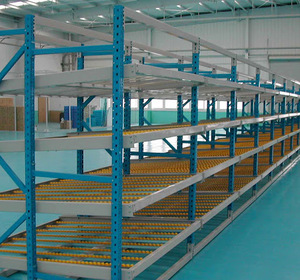
Gravity racking relies on physical contact between the pallet undersurface and precision rollers. In Indonesia, standard 1200 x 1000 mm ISO pallets, Europallets (1200 x 800 mm), and heavy wooden pallets are common. For gravity lanes, wooden pallets must feature solid bottom skids without missing runners, broken chamfers, or loose nails. Excessive bottom board deflection (greater than 1/200th of the span) can impede smooth descent. We routinely assist local clients in validating plastic, wooden, or slave pallet designs prior to roller pitch manufacturing.
How does high relative humidity in Indonesia affect gravity roller beds and steel coatings?
With tropical humidity levels regularly exceeding 80% to 90% in areas like Tanjung Priok and North Jakarta, raw cold-rolled steel requires robust surface treatment. We provide premium industrial pre-treatments followed by thermoset electrostatic epoxy-polyester powder coating cured at 200°C (yielding a dry film thickness exceeding 60-80 microns). For damp environments, outdoor covered staging areas, and cold storage freezers, we supply continuous hot-dip galvanized uprights, zinc-plated roller assemblies, and stainless-steel internal ball bearings to resist oxidation and prevent friction degradation over decades.
Can gravity flow racking comply with Indonesian seismic building codes (SNI 1726)?
Yes. Our structural calculations account for site-specific peak ground acceleration (PGA) coordinates across Java, Sumatra, Bali, and Sulawesi. We utilize high-strength certified cold-formed steel uprights anchored with specialized heavy-duty chemical anchor studs embedded into C25/30 or C30/37 reinforced concrete floor slabs. Each dynamic lane is equipped with mechanical safety brakes, backstops, and pallet separation mechanisms to prevent surge derailment during ground movement.
How do you handle shipping, port clearance, and on-site assembly across Indonesian provinces?
We provide full CIF and DDP delivery terms. Shipments are bundled with protective ocean-freight steel banding and desiccant bags, arriving via key Indonesian ports including Tanjung Priok (Jakarta), Tanjung Perak (Surabaya), and Belawan (Medan). Our technical team coordinates customs documentation (Form E / ASEAN preferential tariff certificates) and deploys factory-certified project managers to oversee local erector crews for precise leveling, laser alignment, and dynamic drop testing.
What is the typical return on investment (ROI) for gravity flow racking compared to standard selective racking?
While initial capital expenditure for gravity rollers and brake mechanisms is higher than static selective steel, clients in Indonesia typically recoup their investment within 18 to 28 months. Savings stem from: (1) 60% reduction in forklift travel distances and fuel/battery usage, (2) Elimination of intermediate operating aisles leading to a 40-70% expansion in pallet capacity within the same building envelope, and (3) Complete elimination of product expiry losses through systematic FIFO execution.