Industrial Racking & Cantilever Systems Tailored for New England Distribution
Explore our precision-engineered structural and roll-formed cantilever racks, high-density pallet shuttles, and long-span steel modules manufactured to withstand high point-loads and rigorous warehouse conditions.
60yrs
Intralogistics Heritage
12
Direct Manufacturing Plants
70+
Export Destination Markets
50klbs
Max Column Upright Capacity
Engineering Whitepaper
Architectural Mechanics of Heavy-Duty Cantilever Racking in High-Density Hubs
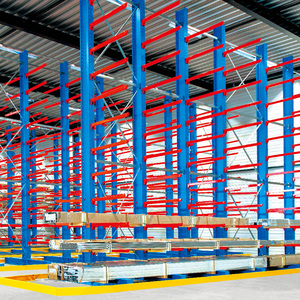
In high-density industrial corridors across Greater Boston—ranging from Chelsea and Everett to the expansive logistics distribution nodes along Route 128 and Interstate 495—the demand for high-capacity non-palletized storage has skyrocketed. Traditional selective pallet racking falls short when storing non-standard, linear materials such as structural steel I-beams, PVC electrical conduits, lumber packs, extruded aluminum, and energy piping. Heavy-duty cantilever racking provides uninterrupted, open-face horizontal storage levels without front columns, eliminating horizontal handling constraints and optimizing cubic building volume.
Our direct manufacturing engineering process evaluates cantilever systems under two primary structural formats: Roll-Formed Steel and Structural I-Beam Steel (ASTM A36 / ASTM A572 Grade 50). Roll-formed systems utilize high-tensile gauge steel with continuous teardrop or slotted adjustability, ideal for light-to-medium retail lumber operations and light piping. However, for severe heavy industrial operations in maritime Boston environments, hot-rolled structural steel cantilever systems deliver unparalleled mechanical toughness. Hot-rolled structural shapes absorb heavy vehicular impacts from side-loaders, reach trucks, and multidirectional forklifts without buckling, ensuring continuous operational integrity.
"Cantilever engineering requires strict accounting for eccentric arm loading and vertical upright deflection. At our 12 manufacturing centers, our structural design protocols adhere precisely to RMI (Rack Manufacturers Institute) MH16.1 specifications and Massachusetts 780 CMR structural provisions, mitigating arm-to-column torsional moment stress."
Every cantilever assembly comprises four foundational components calculated dynamically: the vertical central column, the horizontal load-bearing base, the tapered load arms, and the heavy-duty structural cross-bracing matrix. The column's cross-sectional geometry dictates overall system height and carrying threshold, accommodating loads up to 50,000 lbs per column upright. The load arms are engineered with a precision upward camber (typically 1 to 2 degrees) to offset load-induced elastic deflection under maximum rated capacity. Removable arm-end pipe stops, integrated wire mesh decks, and custom saddle cradles further expand operational flexibility for cylindrical and hazardous cargo.
Mitigating Corrosion in New England's Maritime and Freeze-Thaw Environments
Warehouses and open-air industrial lumber yards across Massachusetts and Eastern New England face relentless exposure to airborne coastal chlorides and harsh freeze-thaw cycles. Bare steel racks deteriorate rapidly under these environmental stresses. To counter rapid galvanic corrosion, our factory deploys two distinct surface protection regimens: an electrostatically applied thermo-cured epoxy powder coating (70–90 microns thick) designed for climate-controlled indoor distribution centers, and a heavy Hot-Dip Galvanized (HDG) coating compliant with ASTM A123 for exterior coastal yards. HDG immersion forms a series of metallurgical zinc-iron alloy layers that provide cathode-sacrificial protection, guaranteeing a maintenance-free outdoor lifespan exceeding 25 years along Massachusetts Bay.
Specialized Deployment Across Greater Boston & Route 128 / I-495
Industrial supply chains across Eastern Massachusetts face astronomical industrial land acquisition costs. Our cantilever systems are custom-configured for the specific economic and physical topologies of New England's primary industrial sectors.
Building Materials & Construction Supply (I-495 Belt)
Distribution centers in Marlborough, Worcester, and Littleton supply rapid residential and institutional commercial construction across Boston. High-capacity, 20-foot-tall cantilever systems with extended structural arms store multi-length engineered lumber, dry-wall bunks, and roofing trusses with 100% immediate product selectivity.
Heavy-Duty Structural I-BeamSteel Service Centers & Metalworking (Middlesex County)
Fabrication shops and steel distribution centers in Woburn and Waltham utilize our extra heavy-duty structural cantilever racks to stage structural steel bar stock, tubing, sheet-metal bundles, and heavy alloy profiles, utilizing integrated steel stop pins to ensure safe manual and overhead crane loading.
Single & Double-Sided UprightsHVAC, Plumbing & MEP Piping Logistics (Quincy & South Shore)
Contractor supply hubs serving downtown Boston commercial retrofits require rapid picker throughput. Our roll-formed cantilever racks equipped with steel wire decking or solid sheet shelf inserts support assorted copper pipe bundles, PVC conduits, and ductwork coils without sagging or localized damage.
Continuous Decked CantileverBiotech & Advanced Manufacturing Infrastructure (Cambridge/Seaport)
Cleanroom-adjacent staging warehouses require rust-free, non-off-gassing racking configurations for specialized pharmaceutical utility piping, stainless steel sanitary tubes, and clean manufacturing modules. Finished in high-durability electrostatic gloss powder coat to eliminate airborne particulates.
Cleanroom Powder Coat FinishExterior Lumber Yards & Coastal Marine Staging (Boston Harbor)
Open-air dockside and municipal storage facilities subject to constant sea salt winds require extreme weather resistance. Our hot-dip galvanized cantilever racks with built-in canopy roof trusses turn exterior storage footprints into sheltered vertical storage, slashing indoor footprint overhead.
ASTM A123 Hot-Dip GalvanizedHigh-Density Guided Narrow Aisle (VNA) Fulfillment
Constrained footprint warehouses utilize custom cantilever designs paired with floor guidance rails or wire guidance for side-loader access. Narrow aisle cantilever layouts reduce aisle widths down to 6.5 feet, generating over 160% storage density gains within legacy Boston industrial buildings.
Very Narrow Aisle (VNA) IntegrationNew England Warehouse Real Estate Trends: The Push for Vertical Density
The Boston metropolitan industrial logistics real estate landscape remains one of the most supply-constrained, high-barrier markets in North America. With industrial lease rates hovering near record highs along the Route 128 inner beltway and strict municipal land use zoning curtailing new horizontal warehouse construction, supply chain operators face intense pressure to maximize existing cubic capacity. Cantilever racking represents a decisive capital investment: by transitioning from floor stacking to a multi-tiered structural vertical cantilever system, facilities instantly expand inventory volume by 300% to 500% within the exact same structural footprint.
Furthermore, municipal permitting across Massachusetts requires strict adherence to seismic performance requirements outlined in the Massachusetts State Building Code (780 CMR / IBC 2021). Even though New England is classified with low-to-moderate seismic acceleration coefficients, cantilever systems bearing continuous linear dead-loads must maintain rigorous base-anchoring engineering calculations and structural cross-brace stiffness. Sourcing directly from an established manufacturing plant equipped with in-house structural engineers ensures that every racking column, arm weld, and seismic base-anchor plate is stamped and certified for Boston building inspector approval.
Why Boston Procurement Leaders Partner Directly with Our Mill
Eliminating domestic dealer and broker middleman margins while providing custom engineering verification, high-volume production speed, and turnkey international freight logistics directly into the Port of Boston (Conley Terminal).
12 Direct Production Facilities
Unmatched manufacturing capacity operating over continuous CNC roll-forming lines, automated robotic welding cells, and dedicated structural steel fabrication shops, assuring precision arm-to-column tolerances.
In-House PE Structural Calculation
Our licensed structural engineers perform comprehensive FEA (Finite Element Analysis) stress simulations, delivering custom load tables, seismic anchoring calculations, and full submittal packages for Massachusetts permitting.
Direct Conley Terminal Maritime Logistics
Specialized export crating, bundled steel nesting, and direct containerized freight shipping straight to Boston's Conley Marine Terminal, backed by bonded customs clearance and coordinated jobsite flatbed delivery.
Technical Comparison: Roll-Formed vs. Heavy-Duty Structural Cantilever
Engineered specifications verified according to ANSI MH16.1, ASTM standards, and Massachusetts state building standards.
| Engineering Criteria | Roll-Formed Cantilever Series | Structural Heavy-Duty I-Beam Series |
|---|---|---|
| Primary Steel Grade | High-Yield Cold-Rolled Carbon Strip (Q235 / Q355B) | Hot-Rolled Structural Wide-Flange (ASTM A36 / A572 Gr. 50) |
| Column Upright Height | 8 ft to 20 ft (2.4m to 6.1m) | 10 ft to 40 ft (3.0m to 12.2m) Free-standing |
| Arm Load Capacity | 500 lbs to 2,500 lbs per arm | 1,500 lbs to 8,000+ lbs per arm (Engineered per project) |
| Upright Column Capacity | Up to 18,000 lbs total capacity | Up to 50,000+ lbs total capacity |
| Arm Adjustability Pitch | 3-inch or 4-inch continuous pin/wedge pitch | 4-inch or 100mm heavy bolted flange pitch |
| Impact Toughness | Moderate (Suitable for general light handling) | Extreme (Engineered to absorb heavy side-loader hits) |
| Surface Protection | Electrostatic Polyester Powder Coat (Indoor only) | Thermo-cured Powder Coat OR ASTM A123 Hot-Dip Galvanized |
| Primary Boston Applications | Retail lumber, copper tubing, PVC piping, molding | Structural steel, heavy timber bunks, outdoor marine yards |
Frequently Asked Questions by Boston Project Engineers & Buyers
Key structural, permitting, and shipping answers to guide your capital racking acquisition.
What permits are required for installing cantilever racks in Greater Boston?
In Massachusetts, industrial steel storage racks over 8 feet in height are classified as commercial structures governed by the Massachusetts State Building Code (780 CMR) and ANSI/RMI MH16.1. Your municipal building department (e.g., City of Boston Inspectional Services Department, Waltham, or Worcester) requires a building permit application accompanied by structural engineering drawings. We provide full calculation packages, load capacity plaques, and certified drawings ready for local Professional Engineer (PE) review.
How do you calculate cantilever arm deflection and safety factors?
Cantilever arms function as true structural cantilever beams under uniformly distributed loads (UDL). Deflection is calculated considering the arm length, steel moment of inertia, modulus of elasticity, and rated weight. In accordance with RMI MH16.1 specifications, our allowable deflection under full rated load is restricted to L/180. Furthermore, all arms are fabricated with an intentional upward camber to compensate for vertical deflection, and all structural connections maintain a minimum structural design safety factor of 1.67:1 to 2.0:1.
Can cantilever racks be installed outdoors in New England winter conditions?
Yes, absolutely. For exterior applications anywhere in Eastern Massachusetts, we engineer custom Hot-Dip Galvanized (HDG) cantilever systems compliant with ASTM A123. Galvanizing seals every weld and interior hollow section against snow, ice, de-icing salts, and coastal ocean air. Additionally, we engineer integrated roof truss arm extensions (canopy systems) that allow you to attach corrugated metal roofing directly over the cantilever bays, shielding valuable inventory from heavy winter snow loads.
What concrete slab thickness is required to support heavy cantilever systems?
Because cantilever uprights bear large overturning moments at the base plate in addition to vertical downward loads, concrete slab engineering is critical. Standard light installations generally require a minimum 6-inch reinforced concrete slab (3,000 to 4,000 PSI). Heavy-duty structural systems carrying 30,000+ lbs per column frequently require an 8-inch to 12-inch slab, or dedicated concrete strip footings underneath the upright bases. We provide detailed base plate anchor hole patterns, anchor shear/tension metrics, and embedment depth specs to your slab engineer.
How does international shipping and export delivery to Boston work?
As a specialized global manufacturer and exporter, we manage full container load (FCL) sea freight via direct shipping routes calling at the Port of Boston (Conley Terminal) or Port of NY/NJ. Our factory packs long structural columns and arms into custom-braced steel shipping cradles to eliminate maritime transit damage. We coordinate directly with your licensed customs broker or supply full DDP (Delivered Duty Paid) turnkey services straight to your warehouse facility anywhere in Massachusetts or broader New England.
How do I determine whether single-sided or double-sided uprights are needed?
Single-sided cantilever racks are designed to sit flush against interior walls or property boundaries, featuring load-bearing arms on only one face of the upright column. Double-sided cantilever columns feature a central upright column with load arms extending from both the front and rear faces, creating a self-balancing "T" configuration ideal for center warehouse storage aisles. Double-sided systems offer vastly superior structural stability and are significantly more cost-effective per storage level since steel column costs are shared between two working faces.
Ready to Engineer Your Heavy Duty Cantilever System?
Whether you require a custom structural layout for a building materials facility in Worcester, an exterior galvanized canopy rack for Boston Harbor, or high-density cantilever storage along Route 128, our senior structural intralogistics team is ready to evaluate your layout plans and provide factory-direct quote submittals within 24 hours.