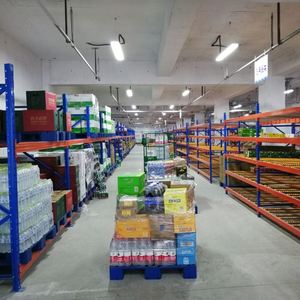
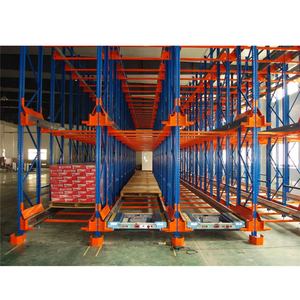
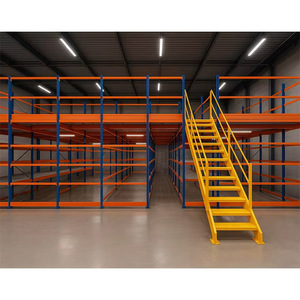
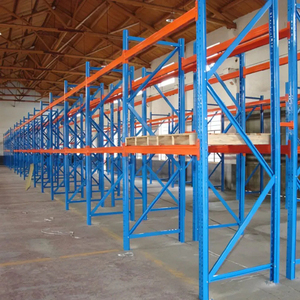
Engineered for seamless First-In, First-Out throughput, equipped with reinforced uprights, speed-brake rollers, and impact-resistant entry guides for heavy building supplies.
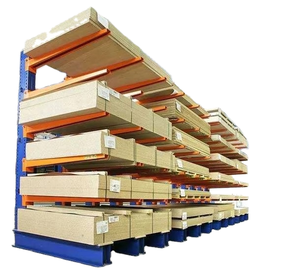
Electrically driven motorized mobile bases carrying high-capacity cantilever arms for long profiles, timber, and sheet metals, maximizing storage footprint.
Whitepaper: Engineering Specifications & Structural Architecture of Heavy Duty Drive-Through Racks
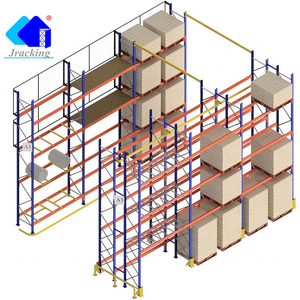
Heavy Duty Drive Through Racking represents the pinnacle of floor-space utilization in modern intralogistics, transforming up to 80% to 85% of warehouse surface area into active pallet cubage. Unlike standard selective pallet systems that mandate handling aisles between every double rack structure, a drive-through installation organizes storage into uninterrupted, continuous lanes accessible from both opposite faces.
This structural layout operates under a strict First-In, First-Out (FIFO) stock rotation inventory model. Pallets enter the lane from the loading aisle (inbound face) and progress systematically toward the unloading aisle (dispatch face). This makes drive-through systems the essential capital investment for facilities handling high-volume, perishable batches, consumer packaged goods (FMCG), cold storage fulfillment, and time-critical pharmaceutical logistics where batch traceability and expiration management are non-negotiable compliance parameters.
"Structural engineering in drive-through systems eliminates traditional horizontal load beams across the lane, transferring all gravity and dynamic seismic forces to continuous cantilevered support rails and heavy-gauge upright portal frames."
Kinematic Analysis & Structural Integrity Under European Norms (EN 15512 & CE EN 1090)
The elimination of intermediate load beams introduces complex torsional stresses, frame buckling liabilities, and horizontal deflection concerns. Certified drive-through manufacturing requires rigorous structural analysis in compliance with EN 15512 (Steel static storage systems – Adjustable pallet racking systems – Principles for structural design) and CE Marking execution standard EN 1090-1 / EN 1090-2 (Execution of steel structures and aluminum structures).
Because forklifts must navigate physically inside the storage bays, the racking frames are vulnerable to recurring cyclic dynamic impacts. Qualified manufacturing facilities employ cold-formed structural steel profiles with exceptional yield strengths (minimum S355JR or Q355B equivalent), engineered with substantial wall thicknesses and continuous omega-shaped profiles that diffuse point collisions along the vertical axis.
Engineering Parameter
Standard Drive-In Racking
Heavy Duty Drive-Through Racking
Automated Radio Shuttle Racking
Inventory Rotation Logic
LIFO (Last-In, First-Out)
Strict FIFO (First-In, First-Out)
Configurable FIFO or LIFO
Aisle Configuration
Single Access Aisle
Dual Access Aisles (Entry & Exit)
Single or Dual Handling Aisles
Space Utilization Rate
75% – 80% of building footprint
70% – 85% of building footprint
85% – 90% (Maximum theoretical cubage)
Forklift Mast Exposure
Deep lane internal travel required
Internal lane travel through corridor
External aisle only (Zero lane ingress)
Top Tie & Portal Bracing
Back X-bracing + Top horizontal ties
Heavy overhead top portals only
Standard spine or frame bracing
Cold Store Energy Efficiency
High thermal density preservation
Superior FIFO cold-chain continuous flow
Highest thermal and operational efficiency
Essential Structural Components and Fail-Safe Safeguards
When procuring heavy duty drive-through racking from an authoritative European or international supplier, structural engineers must verify that the following core components are engineered into the Bill of Materials (BOM):
Structural Cantilever Arms & Support Brackets: Welded or heavy-duty hooked brackets that bolt securely to the upright columns, engineered with upward safety cambers to counteract downward rotational deflection when pallets are staged.
Formed Pallet Guide Rails: Galvanized, continuous cold-rolled steel rails with tapered front flares. These rails self-center pallets as operators steer into the lane, ensuring load stability under dynamic forklift maneuvering.
Heavy-Duty Overhead Bracing Portals: Since rear vertical diagonal bracing cannot be installed across a drive-through lane without blocking throughput, the upper horizontal plane is stabilized by rigid structural truss portals that transfer lateral sway forces directly to adjacent braced towers.
Anchor Plates & Floor Guide Rails: High-tensile floor guide rails (often heavy structural channel or continuous angle profiles) bolted to the concrete slab with chemical resin or M12/M16 expansion anchors, restricting lateral forklift deviation to millimeter tolerances and protecting columns from truck tire and chassis impacts.
Strategic Market Analysis
Future Procurement Trends in Heavy-Duty Industrial Racking (2026–2035)
Industrial supply chain managers and logistics procurement executives face rapid changes across automation, climate resilience, and compliance. Below are the transformative trends shaping the global heavy-duty racking market.
1. Decarbonized Green Steel & EPD Certification
Corporate ESG directives are reshaping tender criteria. Global enterprises now mandate Environmental Product Declarations (EPD) calculating embodied carbon across upstream scrap recycling, electric arc furnace (EAF) smelting, and low-VOC powder coating.
2. Integrated Digital Twin & Structural Health Monitoring
Smart drive-through racks are incorporating IoT-based strain gauges and optical deflection sensors. Structural stress telemetry feeds directly into digital twins, warning warehouse management systems (WMS) of column misalignments before catastrophic failures occur.
3. Hybridization for Autonomous Mobile Robots (AMRs)
Drive-through lanes are being re-engineered with elevated bottom guide clearances to accommodate low-profile AMRs and autonomous counterbalanced reach trucks, shifting manual forklift operations toward autonomous 24/7 continuous replenishment.
4. Cold-Chain Deep Freeze Thermal Ducting Integration
With surging biological pharmaceuticals and frozen grocery demands, drive-through racks are manufactured with thermal air ducting apertures, maintaining consistent -25°C air circulation throughout deep pallet channels to prevent localized hot spots.
5. Heightened Seismic Performance Standards (EN 16681)
Global supply chain resilience standards have elevated baseline structural calculations. Suppliers must demonstrate dynamic seismic modeling under EN 16681, factoring in live pallet friction coefficients, localized tectonic zone metrics, and slab ductility.
Procurement teams are avoiding split-liability contracts. Leading enterprises now partner with single-source manufacturing integrators capable of supplying certified steel, in-house WMS/WCS software suites, and accredited professional installation lifecycles.
Enterprise Authority & Reliability
Direct Engineering Prowess Backed by 60 Years of Intralogistics Innovation
We do not simply distribute steel; we design, calculate, simulate, and fabricate certified industrial racking architectures. With an established commercial network spanning 70+ countries, 12 state-of-the-art production centers, and 7 dedicated R&D technology facilities, our systems safeguard supply chains for leading global enterprises.
In-House Finite Element Analysis (FEA)
Every bay layout is statically and dynamically modeled using specialized FEA structural software to determine exact deflection limits, seismic resistance, and certified load signs.
Automated Mill-Roll Manufacturing
Continuous robotic roll-forming lines, computerized multi-stage punching, and advanced shot-blasting guarantee millimeter tolerances across all upright and rail components.
Accredited CE & ISO Certification
Complete traceability from raw coil mill test certificates (MTC) to certified EN 1090 factory production control (FPC), ensuring seamless municipal permit compliance.
Full Lifecycle Field Support
Global deployment teams manage precision leveling, anchoring inspection, periodic EN 15635 rack safety audits, and rapid spare parts distribution.
Procurement Clarity
Frequently Asked Questions: Heavy Duty Drive-Through Racking Systems
Clear, engineering-backed answers to critical questions asked by procurement officers, warehouse operations directors, and logistics engineers before initiating a layout proposal.
What is the fundamental engineering difference between Drive-In and Drive-Through Racking?
While both systems feature compact internal forklift storage channels without traditional horizontal beams, the core operational distinction lies in access points and inventory rotation logic. Drive-In racking has a single entry/exit face operating on a Last-In, First-Out (LIFO) schedule, supported by vertical cross-bracing at the rear frame. Conversely, Heavy Duty Drive-Through Racking provides dual open faces (entry on one end, exit on the opposite end), enabling a true First-In, First-Out (FIFO) stock cycle. Because rear vertical diagonal bracing cannot be installed across drive-through lanes, lateral structural stability must be secured via reinforced overhead portal cross-beams and robust floor anchorages calculated to counteract dynamic forces.
What specific building and floor slab requirements are needed for heavy drive-through racks?
Because drive-through racking condenses immense point loads onto compact baseplates, the concrete slab must possess certified compressive strength (typically 25 to 35 MPa or higher) and adequate slab thickness (normally 150 mm to 250 mm reinforced concrete). Furthermore, floor flatness is critical to avoid mast lean while forklifts travel deep within the bays. Installations must align with EN 15620 or DIN 18202 standards (often Class 300 or 400). A structural review of the slab's sub-base, soil bearing capacity, and expansion joint locations is always performed during our initial engineering consultation.
What CE certification standards apply to heavy duty pallet racking within the EU and international projects?
Under European regulations, industrial pallet racking must conform to structural design norms EN 15512 (calculation methods) and EN 15620 (tolerances, deformations, and clearances). When racking acts as a building-integrated structure (such as clad-rack warehouses) or falls under harmonized European construction product regulations, CE Marking under EN 1090-1 (Execution Class EXC2 or EXC3) is legally mandatory. Our manufacturing centers operate certified Factory Production Control (FPC) systems, issuing formal Declarations of Performance (DoP) ensuring that your racking system complies with strict municipal fire, safety, and operational insurance standards worldwide.
How are safety hazards mitigated when forklift operators navigate inside narrow drive-through lanes?
Safety mitigation in drive-through systems relies on three distinct layers of physical engineering: First, heavy-gauge floor-mounted guide rails (structural channel or angle iron) physically restrict truck sway, preventing forklift tires or chassis from striking the vertical uprights. Second, high-visibility, wraparound column protectors and reinforced bull-nose end protectors guard the vulnerable entry and exit portal posts against acute turning collisions. Third, pallet support rails feature flared entry guides and physical end-stops that mechanically locate the pallet, preventing load displacement or dislodgement during placement and retrieval.
Can Drive-Through Racking be retrofitted into Automated Pallet Shuttle systems at a later date?
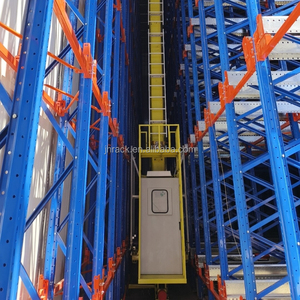
Yes, provided this upgrade pathway is anticipated in the initial engineering study. While traditional drive-through racks use standard formed angle rails for pallet skids, a future-ready system can be planned with upright pitch dimensions and frame load capacities capable of receiving motorized shuttle tracks. When ready to automate, our engineers replace the manual guide rails with precision radio shuttle profiles, instantly converting manual drive-through bays into high-throughput, semi-automated dense storage without replacing the main vertical upright portals.
What core data must be prepared before requesting an engineered layout and budget quotation?
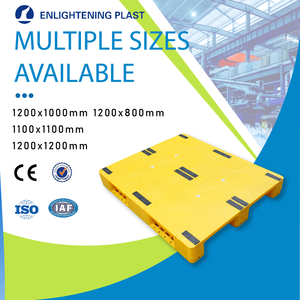
To produce an optimized CAD layout and structural pricing, our engineering team requires: (1) An architectural facility drawing showing clear building height, column grids, fire sprinkler drops, and dock door locations; (2) Pallet unit load specifications including width, depth, height, maximum gross weight, and pallet entry orientation (e.g., Euro 800x1200 or Industrial 1000x1200); (3) Forklift model details specifying collapsed mast height, maximum lift height, and minimum aisle turning clearance; and (4) Throughput requirements and ambient temperature criteria (ambient, cold room, or -30°C deep freeze).
Connect Directly with Our Racking Engineering Specialists
Whether you require a comprehensive layout study, seismic engineering calculation, or custom CE-certified factory-direct quotes for your warehouse project, our technical intralogistics team is ready to assist.