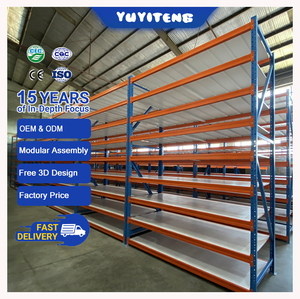
High-Density Warehouse Equipment
Standard & Custom Pallet Racking Systems
Engineered structural racking frameworks meeting EN, FEM, and ANSI specifications, manufactured for high-throughput Malaysian facilities and international export distribution.

60+ Yrs
Intralogistics Engineering Heritage
70+
Countries in Commercial Export Network
12
Specialized Global Production Centres
30%-40%
Volumetric Storage Capacity Uplift
Engineering Whitepaper · System Mechanics
Structural Principles of Double Deep Pallet Racking
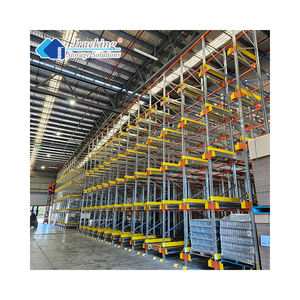
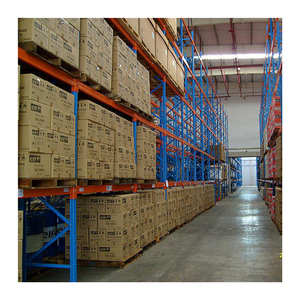
In modern high-density intralogistics, space efficiency is balanced against direct accessibility. Double deep pallet racking addresses this core operational challenge by placing two single pallet racks back-to-back, accommodating four pallet rows between each working aisle. This structural layout eliminates half the access aisles required in traditional selective pallet setups, immediately reclaiming 30% to 40% of overall warehouse floor surface without expanding the building footprint.
Key Mechanical Insight: Double deep configurations operate on a First-In, Last-Out (FILO/LIFO) inventory sequence per pallet lane, making them exceptionally effective for batch-controlled products, FMCG goods with multiple pallets per SKU, and high-throughput cold chain distribution facilities across Peninsular and East Malaysia.
Handling pallets placed two depths away requires deep-reach forklifts equipped with pantograph mechanisms or telescopic tele-forks. Structural engineering must account for eccentric dynamic loading, higher bending moments on front beam profiles, and deflection tolerances. Our systems are engineered using high-tensile structural steel (SS400 / Q235B / Q355B), utilizing 5-hook connector brackets with integrated safety locks to prevent accidental dislodgement during deep-reach insertion cycles.
Engineering Evaluation: High-Density Racking Comparison
Evaluate mechanical parameters, storage densities, handling machinery requirements, and typical floor-slab requirements across standard high-capacity systems.
| Racking Architecture | Space Utilization | Direct Selectivity | Handling Equipment Required | Floor Slab Levelness (DIN 18202) | Optimal Turnover Model |
|---|---|---|---|---|---|
| Double Deep Pallet Racking | 65% – 75% | 50% Direct Accessibility | Deep-Reach Pantograph Forklift | Group 3 (±3 mm over 2m) | FILO / Medium-to-High SKU Batch |
| Standard Selective Racking | 40% – 50% | 100% Direct Accessibility | Standard Counterbalance / Reach Truck | Standard Industrial Finish | FIFO / Unlimited SKU Diversification |
| Drive-In / Drive-Through | 75% – 85% | Per Bay Lane Only | Standard Counterbalance (Must Enter) | Group 3 / Heavy Upright Guide Rails | Strict FILO / Very Few SKUs |
| 4-Way Radio Shuttle Racking | 80% – 90% | Semi-Automated Channel Control | Radio Shuttle Cart + Standard Mast | Group 4 High Precision Flatness | Automated FIFO / FILO Hybrid |
Localized Applications
Deploying Double Deep Racking Across Key Malaysian Sectors
Malaysia's geographic position along the Straits of Malacca places it at the center of Southeast Asian manufacturing and distribution networks. Warehouse operators in Selangor, Johor, and Penang utilize double deep systems to overcome rising commercial land values.
Cold Chain Hubs in Selangor & Johor
Refrigerated warehouse cubic meters carry premium cooling energy costs. Double deep installations in Shah Alam, Bukit Jelutong, and Johor Bahru maximize thermal volumetric density, reducing wasted cubic refrigerated volume by up to 35% compared to selective layouts.
Halal Logistics & FMCG Facilities
Under Malaysia's MS 2400 standard for Halal logistics, segregation of SKUs and complete batch traceability are mandatory. Double deep racking allows two-deep pallet pairs of the same halal production batch to remain segregated with rapid inventory verification.
Electronics & Industrial Exporters
For multinational electronics and semiconductor assembly plants in Penang (Bayan Lepas and Batu Kawan), double deep racking serves as a buffer storage framework between raw material ingestion and export container loading docks.
Industry Dynamics
Macro Trends Driving Storage Modernization in Malaysia
Understanding regional real estate shifts, regional e-commerce consolidation, and seismic safety directives shaping Malaysian supply chains.
Industrial Land Scarcity & Rent Inflation
Industrial prime land lease rates in the Klang Valley and Greater Johor have risen significantly. Double deep systems allow operations to scale upward within existing 10m to 14m clear-height facilities, avoiding high-capital facility relocations.
Seismic Safety Norms (EC8 / MS EN 1998)
With revised earthquake structural design guidelines under Eurocode 8 adaptations in Malaysia, warehouse owners increasingly require certified seismic engineering for heavy industrial upright frames, bracing profiles, and footplate anchorage anchors.
WMS & Telescopic Camera Integration
The convergence of enterprise Warehouse Management Systems (WMS) with camera-assisted deep-reach forklifts enables operators to execute second-depth pick and putaway cycles with minimal operator fatigue and zero pallet impact incidents.
Procurement Knowledge Base
Frequently Asked Questions by Malaysian Warehouse Operators
Technical considerations, operational planning, and procurement answers verified by industrial racking structural engineers.
What aisle width is required for double deep racking in Malaysia?
Aisle widths for double deep installations are governed by the specific turning radius and chassis dimension of the deep-reach truck or pantograph forklift. Typical aisle requirements range between 2.8 meters to 3.2 meters for pantograph reach trucks handling standard 1000mm x 1200mm industrial pallets or 1100mm x 1100mm Asian four-way pallets. A full sweep analysis is performed by our engineering team to ensure adequate operating clearance.
How do operators locate and handle pallets stored in the rear position?
Rear pallets are accessed using specialized material handling equipment (MHE) outfitted with double-reach pantograph scissors or hydraulic telescopic forks. Most modern facilities in Malaysia deploy mast-mounted wireless cameras paired with high-definition in-cabin monitor screens and horizontal line lasers. These guide the fork tines directly into the pallet pockets at lift heights up to 12 meters, minimizing risk of load or beam damage.
Are double deep racks compatible with varied Malaysian pallet standards?
Yes. Malaysian supply chains typically utilize a mix of 1200mm x 1000mm (ISO/Australian standard), 1100mm x 1100mm (common in Japanese/Korean manufacturing), and 1200mm x 800mm (Euro-pallets). Double deep frames are customized in depth—often between 2100mm to 2400mm with intermediate heavy-duty pallet support bars, guide angle brackets, and drop-in wire mesh decking—to safely support diverse pallet configurations without sagging.
What concrete floor slab specifications are needed for heavy double deep loads?
Due to the concentration of weight over a reduced floor area, floor slabs must have adequate point load and uniformly distributed load (UDL) capacities—typically a minimum of 25 kN/m² to 45 kN/m², with concrete strength grades of C25/30 or C30/37. Furthermore, floor flatness compliant with DIN 18202 Group 3 or ASTM E1155 FF/FL standards is recommended to prevent mast sway and lean when lifting loads into the upper second-depth tiers.
How does the LIFO/FILO turnover impact inventory management?
Because the rear pallet cannot be extracted until the front pallet is removed, the system runs on a Last-In, First-Out sequence within each individual two-deep lane. To maximize efficiency without operational bottlenecks (honeycombing), companies assign each double-deep channel to identical SKUs or production batches. Enterprise WMS software effortlessly manages batch locations to preserve FIFO rotations across the warehouse footprint as a whole.
Can double deep pallet racking be converted or relocated in the future?
Yes, our racking systems feature a modular bolt-and-clip engineering framework. Double deep runs can be unbolted and reconfigured into selective pallet racking, narrow aisle (VNA) systems, or integrated with push-back dynamic carts if business throughput profiles evolve. Upright punch profiles allow 50mm or 75mm incremental beam height adjustments without structural cutting or welding.
Enterprise Strengths
Why Global Supply Chains Trust Our Engineering & Export Infrastructure
Combining 60 years of structural know-how with 12 international manufacturing hubs, advanced WMS software capabilities, and full lifecycle project support.
In-House Structural Engineering
Every double deep rack structure is subjected to rigorous finite-element modeling, load calculation, and deflection verification in our 7 dedicated R&D centers, compliant with EN 15512, FEM, and ANSI standards.
Direct Manufacturing Control
Our 12 specialized manufacturing plants utilize automated cold-roll forming, robotic laser welding, and automated thermosetting epoxy powder coating lines, ensuring rigorous quality control and reliable export container shipping.
WMS & Digital Integration
Recognized five times in the Gartner® Magic Quadrant™ for Warehouse Management Systems (Easy WMS), we deliver turnkey interoperability between structural racking layouts and automated inventory management software.
Export & Lifecycle Support
With an active commercial network across 70+ countries and offices in 23 nations, we support clients from initial conceptual CAD planning and export crating to certified on-site assembly, load certification, and ongoing safety audits.
Modernize Your Warehouse With Double Deep Engineering
Connect with our technical storage engineers to review your facility floor plans, calculate load capacities, and receive an optimized double deep layout proposal tailored for Malaysian operations or overseas export facilities.
Contact Us