High-Density Gravity Flow Engineering: Optimizing Brazil's Supply Chains
Meeting the operational demands of ABNT NBR 15524 standards, seismic-zone resilience, and tropicalized logistics infrastructure across Latin America.
Precision Intralogistics: Gravity Flow as the Linchpin of Cost Efficiency
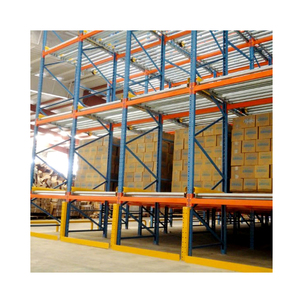
As the Brazilian industrial and consumer markets experience dynamic distribution transformation—spurred by accelerated e-commerce, regional third-party logistics (3PL) expansion in São Paulo, and massive food-processing consolidation across Paraná and Goiás—traditional static pallet storage proves inadequate. Industrial Gravity Flow Racking (also widely designated as Pallet Flow or Live Storage) operates via declining roller lanes utilizing gravitational kinetic force. This design ensures strict First-In, First-Out (FIFO) batch control while eliminating interior forklift corridors, reducing space consumption by up to 60% and cutting operating energy overhead.
Bridging high-volume Chinese manufacturing precision with Brazilian warehouse specifications requires deep structural compliance. Our manufacturing lines leverage certified high-yield Q235B and Q355B structural steel, continuous roll-forming tolerances, and specialized roller bearing technology suited for standard Brazilian PBR-1 pallets (1000mm x 1200mm) as well as standardized Mercosur carton transport.
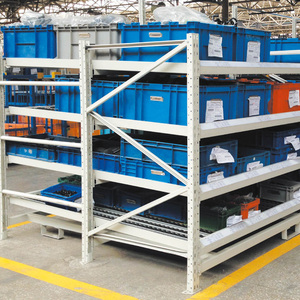
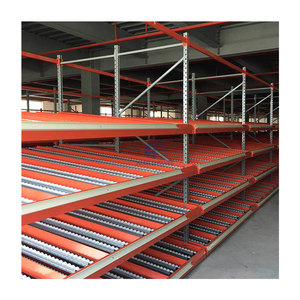
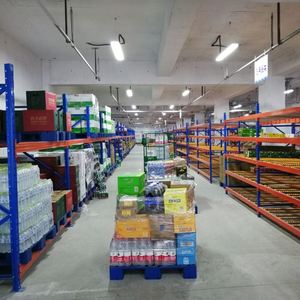
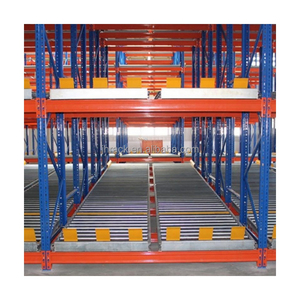
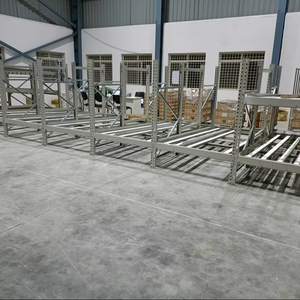
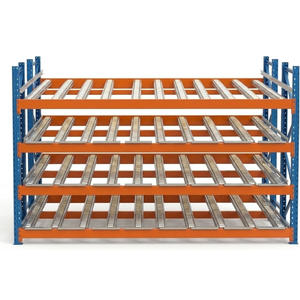
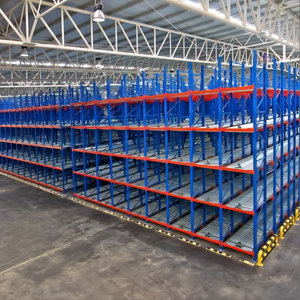
Recommended Gravity Flow Storage Systems
Precision-engineered roller tracks, speed controllers, and high-load steel frames for heavy industrial duty.
Strategic Deployments Across Brazil's Commercial Landscape
Analyzing key industrial segments where gravity flow yields immediate ROI and operational continuity.
Cold Chain & Protein Export (JBS / BRF Hubs)
In temperature-controlled facilities throughout Santa Catarina and Rio Grande do Sul, refrigerated space costs up to 400% more than dry ambient space. Gravity flow systems maximize cubic volume by compacting up to 25 pallets deep in a single lane. FIFO rotation guarantees meat, poultry, and dairy products maintain strict veterinary traceability under SIF inspection guidelines before port arrival at Santos or Paranaguá.
FMCG & Retail Fulfillment (Cajamar Corridor)
The industrial logistics hub of Cajamar (São Paulo) serves as Latin America’s core e-commerce capital. Carton gravity flow and split-case live picking systems allow rapid order assembly, separating replenishing forklifts on the rear charging aisle from active picking operators on the front discharge face, drastically minimizing internal traffic bottlenecks and elevating picker ergonomics.
Pharmaceutical & Cosmetics (ANVISA Compliance)
Under ANVISA Resolution RDC 430/2020, pharmaceutical warehouses must guarantee strict batch, expiry, and FEFO/FIFO operational protocols. Industrial gravity flow ensures inventory mechanically rotates in chronological order. Combined with non-contaminating galvanized or electrostatic epoxy finishes, our racks resist humidity corrosion in tropical Brazilian climates without particulate flaking.
Engineered Specifications for the Brazilian Market
Precision-calculated structural parameters ensuring seamless interface with Brazilian PBR Pallets.
| Technical Parameter | Standard Industrial Pallet Flow | Heavy-Duty Dynamic Buffer | Carton Flow Order Picking |
|---|---|---|---|
| Supported Pallet Type | PBR-1 (1000 × 1200 mm) / Euro Pallet | PBR-1 / Industrial Skids / Chep | Plastic Totes / KLTs / Corrugated Boxes |
| Load Capacity | 500 – 1,500 kg per pallet position | 1,500 – 2,500 kg per pallet position | 25 – 80 kg per running linear meter |
| Gradient / Slope Ratio | 3.0% – 3.8% (Self-regulating) | 3.5% – 4.0% with safety dampers | 4.0% – 5.5% (Configurable pitch) |
| Steel Grade & Thickness | Q235B / Cold-Rolled 2.0 – 2.5 mm | Q355B / Reinforced Cold-Rolled 3.0 mm | Q235 High-Tensile Structural Steel |
| Braking & Separator System | Centrifugal Roller Brakes + End Stops | Magnetic/Hydraulic Brakes + Safety Separator | Integrated Front Pick-Stop / Guide Rails |
| Surface Protection | Epoxy Polyester Powder (80-120μm) | Hot-Dip Galvanized / Anti-Corrosive Epoxy | Zinc-Electroplated / Powder Coated |
Intralogistics Dynamics in Brazil: The 2025–2030 Horizon
Key economic and regulatory vectors shaping high-density warehouse storage adoption.
Urban Space Scarcity & Real Estate Premiums
Class A warehousing lease prices within a 30 km radius of São Paulo, Campinas, and Rio de Janeiro have hit historical peaks. Companies can no longer justify wide forklift transit aisles in static selective layouts. Gravity flow racking concentrates storage into compact multi-lane blocks, delivering immediate density gains without requiring new real estate acquisitions.
Energy Cost Mitigation in Green Logistics
Unlike powered automated storage and retrieval systems (AS/RS) that require continuous electricity draw, industrial gravity flow operates entirely on gravitational kinetic energy. This empowers Brazilian corporations targeting ESG metrics and ISO 50001 energy standards to lower their carbon footprints while optimizing internal pallet handling speeds.
Integration with WMS & Digital Twins
Brazilian operations are rapidly deploying advanced WMS suites (including cloud integrations) that map pick-faces and lane capacities in real time. Our gravity flow installations provide structured modular lanes, easily paired with IoT pallet presence sensors and pick-to-light systems for real-time inventory visibility.
Resilience Under Mercosur Pallet Variances
While the Brazilian PBR-1 wooden pallet is standard, regional supply chains encounter diverse pallet conditions and bottom-board configurations. Our gravity flow systems integrate split-roller designs and graduated braking units that accommodate bottom deflection, preventing pallet hangs and lane blockages.
Enterprise Manufacturing & Global Integration Strength
Direct manufacturing excellence backed by 60 years of intralogistics expertise and worldwide project delivery.
12 Advanced Production Centers
Operating across 12 high-capacity production bases, our manufacturing lines integrate continuous cold roll-forming, automated robotic welding, and German automated electrostatic powder-coating systems. This gives full control over raw steel quality, structural integrity, and punctual international ocean-freight delivery.
7 Dedicated Intralogistics R&D Hubs
Our 7 dedicated research centers lead industry innovation in dynamic flow control, pallet impact absorption, and automated material handling interfaces. Recognized 5 times in the prestigious Gartner® Magic Quadrant™ for Warehouse Management Systems, we align static rack infrastructure with sophisticated software orchestration.
Localized Engineering Support in Hortolândia
With an established presence in Brazil (office situated in Hortolândia, SP), our Portuguese-speaking engineering staff provide localized structural design, load capacity calculations, on-site installation guidance, and technical lifecycle inspections aligned with Brazilian safety standards (NR-11 and NR-12).
Frequently Asked Questions for Brazilian Procurement Teams
Direct technical and commercial answers regarding imports, customs compliance, and system commissioning.