Certified Core Products for Industrial & Warehouse Operations
Precision-machined structural racks and high-density shuttle storage systems tested to withstand intense warehouse throughput and rigorous seismic load factors.
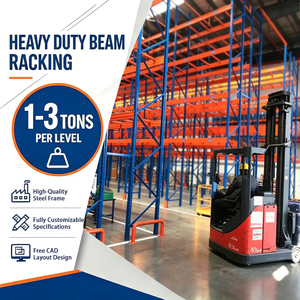
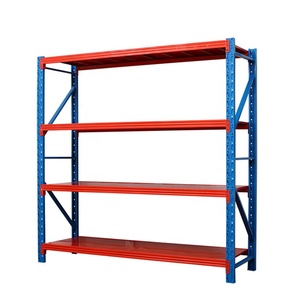
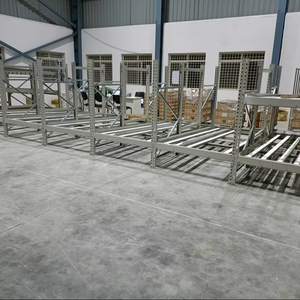
High-Density Radio Shuttle Systems: The Definitive Solution for South Korea's Real Estate Dynamics
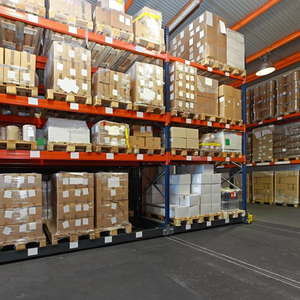
South Korea’s intralogistics landscape faces a unique convergence of geographic, fiscal, and operational constraints. In primary logistics corridors such as Gyeonggi-do (encompassing Icheon, Yongin, Anseong, and Pyeongtaek), logistics industrial land acquisition costs have risen sharply, driving an urgent need for maximum vertical volumetric utilization. Traditional selective pallet racking, requiring standard 3.2-meter to 3.8-meter operating aisles for reach trucks and counterbalance forklifts, yields an effective floor utilization rate of merely 35% to 42%. In contrast, high-density Radio Shuttle Racking systems eliminate internal operating access aisles entirely, replacing open void space with continuous deep-lane storage that elevates floor volumetric efficiency to beyond 82%.
As a global tier-one intralogistics pioneer with over 60 years of structural engineering heritage, 12 production facilities, and 7 advanced research and development centers worldwide, we design, fabricate, and commission high-density semi-automated Radio Shuttle platforms tailored directly to South Korean commercial standards. By bridging heavy-duty cold-formed structural steel profiles with cutting-edge optical, laser-guided autonomous shuttle carriers, our installations deliver flawless pallet handling while drastically reducing forklift operational travel distances, equipment collision hazards, and electrical power consumption in climate-controlled facilities.
Engineering Standards for South Korean Industrial Compliance
How our radio shuttle racking architecture meets the localized demands of South Korean building codes, pallet sizing, and seismic protection.
KS A 2164 (T-11) Pallet Architecture
South Korean industrial supply chains revolve universally around the Korean Standard KS T-11 pallet format (1,100 mm × 1,100 mm square profile), differing fundamentally from European standard EUR-pallets (800 × 1,200 mm) and North American GMA spec (40 × 48 inches). Our radio shuttle tracks, entry funnel guides, and optical positioning sensors are engineered specifically for the dynamic center-of-gravity shifts inherent to 1,100 mm square platforms, guaranteeing that 4-way pallet entry points align securely on load-bearing shuttle rails without overhang binding or deflection.
Standard KS A 2164 CompatibilityKDS 41 Seismic Structural Load Analysis
Under the updated Korean Design Standard (KDS 41) and the Korean Building Code, high-bay metal racking systems are regulated as non-building structures subject to strict spectral acceleration checks. Our structural engineers calculate upright section profiles, bracing diagonals, and baseplate anchorage configurations using non-linear dynamic time-history simulations. Heavy baseplates and high-tensile epoxy anchor assemblies distribute shear force into concrete floor slabs, ensuring collapse-proof performance during regional seismic events.
Seismic Zone I & II CertifiedSub-Zero Thermal & Battery Chemistry
Operating automated electronics inside South Korea’s intense sub-zero fishery hubs and rapid cold-chain facilities requires specialized component engineering. Our Radio Shuttle units incorporate IP65-sealed drive motors, heated sensor optics to prevent condensation icing, cryogenic cold-rated structural steel (tested for Charpy V-notch impact resistance at -30°C), and advanced Lithium Iron Phosphate (LiFePO4) battery packs featuring internal thermostatic heating blankets for rapid charging cycles.
Cold Chain Rated Down to -30°CComparing High-Density Storage Methodologies in South Korea
An objective comparison of intralogistics efficiency metrics for procurement engineers evaluating deep-lane automation versus legacy methods.
| Storage System Type | Volumetric Space Density | FIFO / LIFO Rotation Versatility | Forklift Cycle Travel Reduction | Cold-Store Operating Cost Index | KDS 41 Seismic Resiliency |
|---|---|---|---|---|---|
| MECALUX Radio Shuttle Racking | Very High (82% - 88%) | Dual Capability (FIFO & LIFO Lane Modes) | Up to 75% Reduction | Lowest (Maximizes Refrigeration Volume) | Engineered Ductile Bracing |
| Traditional Selective Pallet Rack | Low (38% - 44%) | 100% Selectivity (Any Sequence) | Baseline (High Travel Time) | Highest (Chilling Empty Aisle Space) | Standard Column Anchoring |
| Drive-In / Drive-Through Racks | High (65% - 72%) | LIFO Only (Drive-In) / FIFO (Drive-Through) | Slow (Forklifts Travel Inside Racks) | Moderate (High Rack Impact Risk) | Prone to Progressive Torsional Deflection |
| Gravity Pallet Flow Racking | High (70% - 78%) | Strict FIFO Only | Up to 50% Reduction | Moderate (Mechanical Roller Wear in Cold) | Heavy Roller Track Deadload |
| Mobile Pallet Racking | High (75% - 82%) | 100% Selective (One Aisle Open) | Aisle Shift Wait Time Incurred | Low (Good Thermal Density) | Floor Rail Grouting Restrictions |
Where Radio Shuttle Technology Powers Korean Industry
From mega-fulfillment e-commerce parks in Gyeonggi-do to cold-storage corridors in Busan New Port, our systems resolve mission-critical throughput bottlenecks.
E-Commerce & Dawn Delivery Hubs
South Korea’s revolutionary "Dawn Delivery" (Saetbyeol Delivery) and hyper-accelerated rocket logistics platforms operate under compressed dispatch windows between 23:00 and 06:00. In fulfillment centers located throughout Yongin and Icheon, radio shuttle systems operate as massive dynamic buffer zones. Palletized fast-moving consumer goods (FMCG) are sequenced and retrieved in deep lanes, staging thousands of SKUs ready for multi-tier sorting systems without forklift congestion at loading docks.
High-Throughput Inbound BufferingBusan Port Refrigerated Seafood & Meat
As the sixth-largest container port globally, Busan serves as Northeast Asia's primary maritime transshipment hub for frozen fisheries and meat. Refrigeration accounts for over 60% of an operational cold store's overhead. Our cold-rated radio shuttle systems allow operators to pack up to 40 pallets deep per channel across 6 tiers. By compressing the volume of air requiring active refrigeration, facility operators achieve up to 38% direct savings on industrial electricity tariffs.
Sub-Zero Energy OptimizationAutomotive Component & Battery Production
Supplying domestic automotive assembly plants in Ulsan, Gwangju, and Asan requires rigid just-in-time (JIT) and just-in-sequence (JIS) replenishment. Heavy raw steel stampings and EV battery component crates (often weighing between 1,200 kg and 1,500 kg per pallet) are buffered within robust structural shuttle lanes. Radio shuttle systems integrate seamlessly with automated guided vehicles (AGVs) and lifters, eliminating line starvation on rapid production schedules.
1,500 kg Heavy-Duty Load CapacityIntelligent Automation Trends Shaping Korean Warehousing
The South Korean logistics industry is navigating acute demographic transitions and stringent occupational safety standards overseen by the Korea Occupational Safety and Health Agency (KOSHA). These factors are accelerating a structural departure from manual equipment operations toward fully autonomous internal goods transport. Key transformative trends include:
4-Way Shuttle Racking Convergence
Transitioning from traditional 2-way linear shuttles to multi-directional 4-way systems. 4-way shuttles traverse transverse channels autonomously, enabling individual robotic carriers to reposition goods along both X and Y axes, dramatically reducing dependency on vertical mast stackers.
WCS & AMR Autonomous Cross-Docking
Autonomous Mobile Robots (AMRs) directly feeding radio shuttle pickup stations. Inbound pallets transferred via roller-bed AMRs eliminate human operators from storage aisles entirely, boosting safety while enabling continuous 24/7 dark-warehouse operation.
K-ESG & Carbon Neutral Warehousing
Korean enterprises are subject to rigorous ESG disclosures. High-density shuttle systems reduce facility floor footprint by up to 50%, directly cutting construction embodied carbon, LED lighting loads, and active heating/cooling thermal emissions.
Why Korean Supply Chain Leaders Partner with MECALUX RACKING
Six decades of intralogistics mastery recognized globally by industry leaders and independent Gartner analysts.
Gartner® Magic Quadrant™ Recognition
Recognized repeatedly in the Gartner® Magic Quadrant™ for Warehouse Management Systems (WMS). Our Easy WMS, WES, and WCS software suites provide seamless end-to-end orchestration, integrating physical radio shuttle hardware with existing ERP systems (SAP, Oracle, Douzone) without costly third-party middleware.
Easy WMS Software Architecture12 Direct Manufacturing Plants
With 12 state-of-the-art production facilities and 7 dedicated technology R&D centers, we retain absolute control over steel metallurgy, profile roll-forming tolerances, robotic welding integrity, and epoxy powder coating quality. We eliminate intermediary trading markups and guarantee certified supply-chain delivery schedules.
Direct Factory Supply ChainTurnkey Lifecycle Assurance
Serving clients across 70+ countries worldwide, our engineering support spans layout feasibility studies, 3D structural modeling, local authority permitting assistance, certified installation, commissioning, and scheduled preventative maintenance inspections to guarantee maximum operational uptime.
Full Lifecycle Project EngineeringFrequently Asked Questions by Korean Logistics Buyers
Detailed answers addressing regulatory compliance, operational safety, and system integration across the Republic of Korea.
How does your Radio Shuttle system accommodate the South Korean standard KS T-11 pallet?
What structural calculations are conducted to satisfy the Korean Building Code (KDS 41) for seismic design?
How do fire safety regulations under the Korean Fire Services Act impact high-density shuttle racking?
What is the expected operating battery lifespan and charging duration for cold-store operations (-25°C)?
Can the radio shuttle system be integrated with our existing ERP or Warehouse Management Software?
What floor slab tolerances (flatness and leveling) are required for high-density shuttle racking installations?
Request Your Custom Korean Warehouse Engineering Study
Provide your warehouse dimensions, pallet specifications, and throughput targets. Our intralogistics engineering specialists will generate a complete 3D layout simulation, seismic structural calculation assessment, and comprehensive ROI analysis.